The two week wait (TWW) is what the trying-to-conceive community calls the stretch between ovulation and when a pregnancy test can actually tell you something reliable. It gets its name from the average luteal phase length of about 14 days, the gap between ovulation and the next period in a typical cycle. Most people who’ve lived through it know the feeling: too early to know, too late to do anything but count the days. This article covers what is actually happening during those days, specifically the biology of implantation and hCG rise, and when a test can realistically detect a result. It leaves symptom spotting aside, because the science on individual early pregnancy signs during the TWW is genuinely unreliable. If you want to understand the wait rather than just endure it, keep reading.
The two week wait runs from ovulation to the first day of a missed period or a positive test. Implantation typically occurs between 6 and 12 days after ovulation, per Wilcox et al. (1999). The pregnancy hormone hCG only starts rising after implantation, so tests taken before 10 DPO will miss most positives even when conception has occurred.
Why the Two Week Wait Isn’t Always 14 Days
The “two weeks” comes from the average luteal phase in a textbook 28-day cycle. Luteal phases aren’t fixed, though. A luteal phase of 10 days is common; 16 days is also within normal range. If yours runs short, the wait ends sooner. If it runs longer, you wait more.
Days past ovulation, or DPO, is how most people in the trying-to-conceive community count time during the TWW. Day 1 DPO is the day after confirmed ovulation, and the TWW ends whenever the luteal phase does.
Implantation timing adds another layer of variation. A pregnancy that implants on day 12 post-ovulation will show a positive test several days later than one that implants on day 8, even for the same person in different cycles. This is one reason the TWW can feel unpredictable even when cycle lengths are consistent.
A 1999 study in the New England Journal of Medicine by Wilcox et al. examined 221 menstrual cycles in women actively trying to conceive. In the 102 cycles that resulted in a detectable pregnancy, researchers identified the exact day of implantation using daily hCG measurements. Implantation occurred between 6 and 12 days after ovulation, with the peak days being 8, 9, and 10 DPO, accounting for the large majority of successful conceptions in the cohort. Implantations on day 10 or later showed higher rates of early pregnancy loss compared to those on days 8 and 9. Because the embryo begins producing hCG only once it has burrowed into the uterine lining, a pregnancy test cannot detect anything before that process is complete. At 6 DPO, most embryos haven’t yet reached the uterus. At 8 to 9 DPO, the earliest implantations are only just completing, and hCG production has barely started. A test taken on those days will almost always read negative regardless of whether conception has occurred.
How to Know When Your Two Week Wait Has Started
The TWW begins the day after confirmed ovulation. “Confirmed” matters here, because cycle-day estimates can be off by several days, and an off estimate shifts the entire test-timing calculation.
Two methods give the most reliable ovulation confirmation. An LH surge on an ovulation test means the hormonal signal for ovulation has fired; ovulation itself typically follows within 12 to 36 hours. A thermal shift on a basal body temperature (BBT) chart confirms after the fact that ovulation has passed, usually visible as a sustained rise of 0.2 degrees Celsius or more.
Using both together gives the clearest picture: the LH surge tells you ovulation is coming, the temperature shift confirms it happened. Many people use the date of the LH surge peak plus one day as their day 0, which sets the DPO count for the rest of the cycle.
If you don’t have an ovulation confirmation date, test timing becomes an estimate. The ovulation calculator on this site estimates your likely ovulation day from your last period and average cycle length, which gives a rough TWW start date when OPK or BBT data isn’t available.
How hCG Builds After Implantation
Once the embryo implants, it begins producing human chorionic gonadotropin (hCG). This hormone signals the corpus luteum, the structure left behind after ovulation, to keep producing progesterone so the uterine lining stays in place.
hCG levels start very low. After implantation at around 9 DPO, measurable hCG in blood can appear at 10 or 11 DPO. Urine hCG lags behind blood by a day or two, because it takes time for the hormone to reach the kidneys and concentrate in the bladder.
In a healthy early pregnancy, hCG roughly doubles every 48 to 72 hours, per ACOG guidelines on early pregnancy. At 10 DPO, urine levels might be in the range of 5 to 15 mIU/mL. By 12 DPO, the same pregnancy may have climbed to 10 to 50 mIU/mL. By 14 DPO, roughly the expected period day, many pregnancies sit somewhere between 50 and 200 mIU/mL. These are population ranges, not targets.
This doubling rate is why two tests taken just 48 hours apart during the TWW can look completely different. A barely-there shadow at 10 DPO can become a clear second line two days later.
First-morning urine gives the most concentrated hCG sample of the day. Testing later in the day after drinking a lot of fluids can dilute the sample enough to push a borderline result below the detection threshold, which is why most manufacturers recommend morning testing. If a result at 12 or 13 DPO looks very faint, retesting the next morning with first-morning urine is the clearest next step, as described in the manufacturer’s instructions.
When a Pregnancy Test Goes Positive in the Two Week Wait
Most standard home pregnancy tests detect hCG at 20 to 25 mIU/mL. The First Response Early Result (FRER) claims detection down to 6.3 mIU/mL per its manufacturer’s labelling, making it one of the most sensitive options available.
Sensitivity only matters when there is enough hCG to detect. Based on the Wilcox implantation window, a test taken before 10 DPO will miss most pregnancies even when conception happened. Most pregnancies that implanted on the peak days (8 to 10 DPO) won’t cross the standard 20 to 25 mIU/mL detection threshold until around 12 to 14 DPO.
The NHS recommends testing on the first day of a missed period, which is approximately 14 DPO for a 28-day cycle with ovulation on day 14. That timing catches the majority of pregnancies that have successfully implanted.
An earlier test isn’t necessarily wrong. A negative at 10 or 11 DPO doesn’t rule out pregnancy; it may just mean hCG hasn’t climbed far enough yet. A faint line on the test at that point can represent a real but low hCG signal. The When to Test Calculator estimates your best test window based on your ovulation date and the brand you’re using.
Digital tests, like the Clearblue Digital, typically detect hCG at 25 mIU/mL. They’re less sensitive than pink dye line tests but give a clear “Pregnant” or “Not Pregnant” readout with no line interpretation needed. During the early TWW days when line tests are showing faint results, a digital test can come back “Not Pregnant” even when a sensitive line test would show a faint positive, simply because the hCG hasn’t yet crossed the digital threshold.
The waiting-and-testing hub has guides on reading each test type once you’re ready to test.
What a Negative at the End of the TWW Means
A period arriving on schedule after a negative test most often means conception didn’t happen in that cycle, or the embryo didn’t successfully implant. These are the two most common outcomes in any single cycle, including for people with no underlying issues.
Less commonly, implantation occurred late (day 10 to 12) and hCG started rising, then fell before the period was missed. The Wilcox data shows these later implantations carry higher rates of early loss. A very faint positive that disappears, or a positive followed quickly by a period, falls into this category. Your provider is the right person to speak with about what repeated results mean in your situation.
A negative on the expected period day is reliable when ovulation timing was confirmed. When ovulation timing was uncertain, the test may have been taken too early rather than truly negative. Testing again a few days later, using the schedule in the manufacturer’s instructions for your specific test, can clarify.
How Pregnancy Test Checker Helps During the Two Week Wait
Reading a test at 10 or 11 DPO can be genuinely difficult. At that stage the line can be so faint that it’s hard to tell whether there is anything there at all, or whether it’s an evaporation line appearing after the reading window.
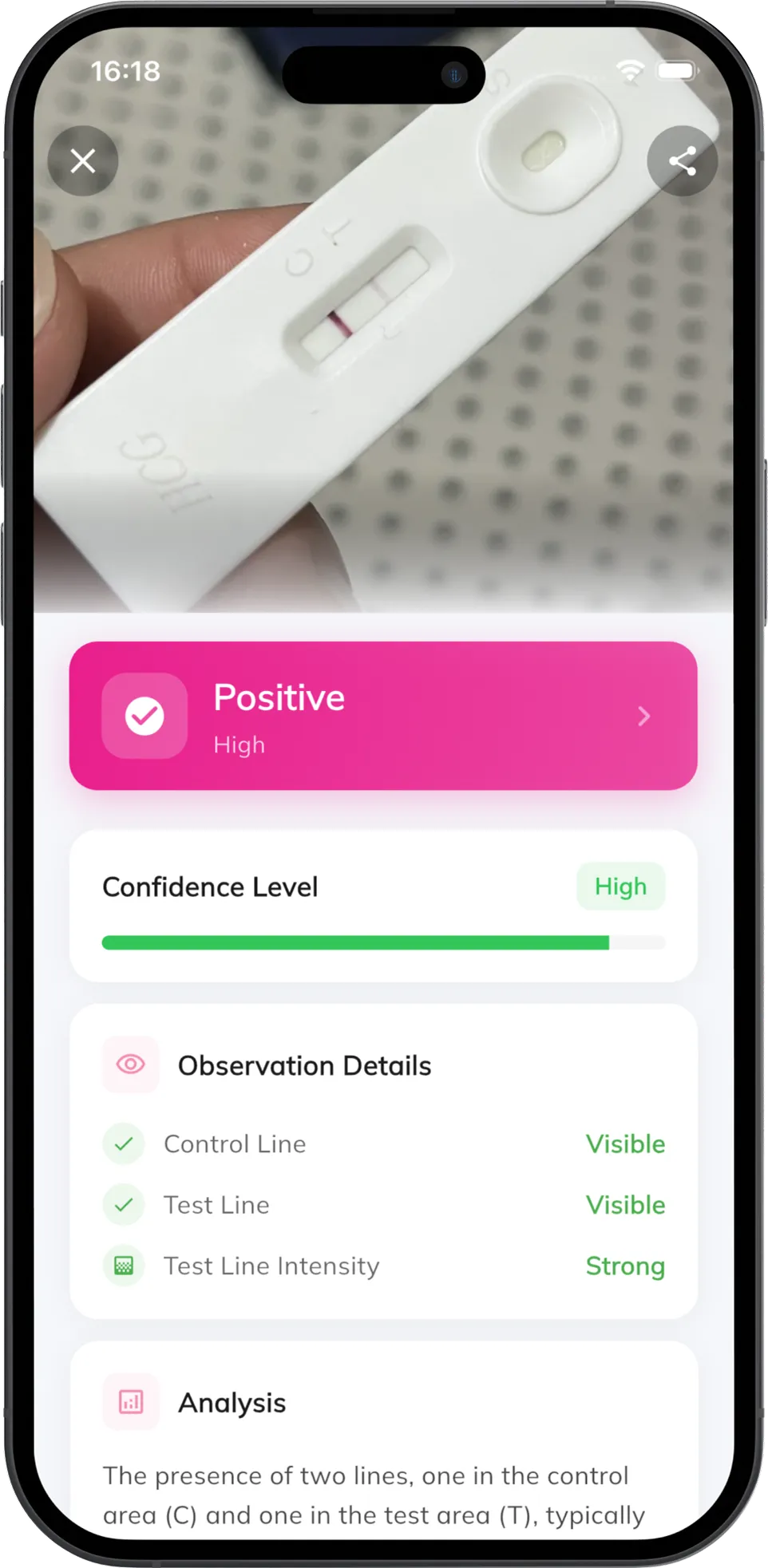
Pregnancy Test Checker + scans a photo of your test and identifies the test line, including lines that are barely visible. It supports over 11 brands including First Response and Clearblue, and shows a confidence score alongside the reading. All processing stays on your device; nothing is uploaded or stored.
The app reads line-based pregnancy tests during the TWW. It’s built for exactly this stage: watching a test for the faintest signal that something has changed.
Sources
- Wilcox AJ, Baird DD, Weinberg CR. “Time of Implantation of the Conceptus and Loss of Pregnancy.” New England Journal of Medicine, 1999. https://www.nejm.org/doi/full/10.1056/NEJM199906103402304
- NHS. “Trying to get pregnant.” National Health Service, UK. https://www.nhs.uk/pregnancy/trying-for-a-baby/trying-to-get-pregnant/
- ACOG Practice Bulletin No. 200, “Early Pregnancy Loss.” American College of Obstetricians and Gynecologists, 2018. https://www.acog.org/clinical/clinical-guidance/practice-bulletin/articles/2018/06/early-pregnancy-loss
- First Response. “Early Result Pregnancy Test.” Church & Dwight. https://www.firstresponse.com/en-us/products/pregnancy-tests/early-result-pregnancy-test