You’ve got a “Pregnant” result on your Clearblue digital test, and then a second number appears: 1-2, 2-3, or 3+. Most people expect those digits to tell them how far along they are. They don’t, at least not the way your midwife counts it. The number shows weeks since conception, not weeks since your last period, which is how gestational age is typically measured. Understanding that gap makes the reading useful instead of confusing.
The Clearblue weeks indicator is a built-in feature on the Clearblue Digital Pregnancy Test with Weeks Indicator. After confirming pregnancy, the test estimates when conception happened and displays one of three possible readings. This guide covers what each one means, how the test calculates it, and what the manufacturer says about its accuracy. No interpretation is given for any specific result.
This post is part of the waiting and testing stage of the journey here.
The Clearblue weeks indicator shows weeks since conception. A reading of 1-2 means conception was roughly 1 to 2 weeks ago, equivalent to about 3-4 weeks pregnant in standard dating. A reading of 2-3 corresponds to approximately 4-5 weeks pregnant. A 3+ reading means roughly 5 or more weeks pregnant. Per Clearblue’s product information, the weeks indicator is 93% accurate for estimating when conception occurred.
What the Clearblue Weeks Indicator Actually Measures
The most common source of confusion is a two-week gap between how the test counts and how your provider counts.
Doctors and midwives date pregnancy from the first day of your last menstrual period (LMP), even though conception hadn’t happened yet at that point. The convention exists because most people remember their last period more reliably than the exact day they ovulated. Conception typically occurs around two weeks after the LMP, in the middle of a standard 28-day cycle.
The Clearblue weeks indicator counts from conception, so its reading runs roughly two weeks behind the gestational age your midwife will use. A reading of 1-2 on the test doesn’t mean 1-2 weeks pregnant. It means conception was 1-2 weeks ago, and you’re approximately 3-4 weeks along by LMP dating.
Here’s how each reading converts:
| Clearblue display | Weeks since conception | Approx. gestational age (LMP) |
|---|---|---|
| 1–2 | 1–2 weeks ago | ~3–4 weeks pregnant |
| 2–3 | 2–3 weeks ago | ~4–5 weeks pregnant |
| 3+ | 3+ weeks ago | ~5+ weeks pregnant |
The indicator shows only three categories because it works on hCG thresholds, not a continuous concentration measurement. It places your result into a broad window. Your first dating scan, which the NHS recommends at 8-12 weeks, gives the precise gestational age.
The Clearblue Digital Pregnancy Test with Weeks Indicator contains two hCG detection strips inside the same test stick. One strip is highly sensitive and responds at low hCG levels, typical of the earliest days after a fertilised egg implants. The second strip has lower sensitivity and fires only when hCG has risen to a higher threshold, consistent with a more advanced pregnancy. Together they create three measurable bands: a result below the first threshold returns 1-2, a result between the two thresholds returns 2-3, and a result above the upper threshold returns 3+. The feature assumes conception occurred the day after the urinary LH surge (the event that triggers ovulation), based on published data on how urinary hCG rises in early pregnancy. Per Clearblue’s healthcare professional documentation, a study of 187 women found the weeks result agreed with ultrasound dating 97% of the time. Clearblue’s consumer product information states the weeks indicator is 93% accurate for estimating when conception occurred.
How the Test Calculates the Reading
The Clearblue Digital test with Weeks Indicator runs two separate detection processes inside one stick.
The first process works like any standard pregnancy test: it detects hCG in the urine sample and, if found above the baseline threshold, shows “Pregnant” on the display.
The second process measures hCG concentration against two fixed thresholds. Depending on where your sample falls, the test returns one of the three weeks readings. These thresholds were built using reference data on how urinary hCG rises relative to the LH surge, the hormonal spike that precedes ovulation by roughly 24-36 hours.
The display runs in two stages. “Pregnant” appears first. Then a flashing symbol shows while the weeks calculation completes. Per Clearblue’s product instructions, the full result can take up to 3 minutes to appear. Clearblue’s instructions say to wait until the flashing stops before reading the weeks figure.
The test assumes ovulation followed the LH surge by one day, which is the most common pattern. If your ovulation timing differed, the weeks reading may not match your own estimate.
How Accurate Is the Clearblue Weeks Indicator?
The pregnancy detection part of the test is highly reliable. Per Clearblue’s product information, it’s more than 99% accurate from the day of the expected period.
The weeks indicator carries more uncertainty. Clearblue’s stated accuracy is 93% for estimating when conception occurred. The HCP study of 187 women showed 97% agreement between the weeks display and later ultrasound dating, using the same three-category structure.
Several factors can shift the reading away from the expected result:
- Urine dilution. Later in the day, after drinking fluids, hCG concentration in urine drops. A more dilute sample can fall into an earlier threshold band than it would with concentrated morning urine. First morning urine gives the most reliable weeks reading.
- Late implantation. If the fertilised egg implanted later than average, hCG production started later. The test might return a reading that appears earlier than the actual conception timing.
- Multiple pregnancy. Carrying twins or more raises hCG faster and at higher levels, which can push the weeks result into a later category sooner than a singleton pregnancy would.
The weeks result isn’t a clinical dating tool. A 3+ reading can correspond to anywhere from roughly 5 to 9 or more weeks pregnant in gestational terms — the test has no upper limit on what 3+ covers. The dating scan narrows this down to the actual gestational age.
What to Do With Your Reading
The most practical use of the weeks indicator is confirming you’re broadly in the early pregnancy range, not pinpointing a date.
When you contact your midwife or GP, convert the reading to gestational weeks first by adding two weeks. Telling your provider you’re “about 4-5 weeks” (if your display showed 2-3) is more useful than reporting the Clearblue figure directly.
If you’re testing before a missed period and get a 1-2 result, keep in mind that very early readings carry more variability. hCG levels are low, and the threshold between categories is narrower at that stage. The manufacturer’s instructions describe testing again a few days later if you want a clearer reading, as hCG doubles approximately every 48-72 hours in early pregnancy.
If your weeks reading seems off compared to when you believe you ovulated, that discrepancy is worth noting. It doesn’t necessarily mean something is wrong — late ovulation is common — but it’s worth mentioning at your first appointment. The when-to-test calculator can help you estimate your cycle timing before you test.
Using Pregnancy Test Checker Alongside Your Clearblue Test
The Clearblue Digital with Weeks Indicator shows a clear text result and number, so there’s nothing ambiguous to interpret visually. But many people also run a standard line test at the same time, particularly an early-response strip to track line progression across the two-week wait.
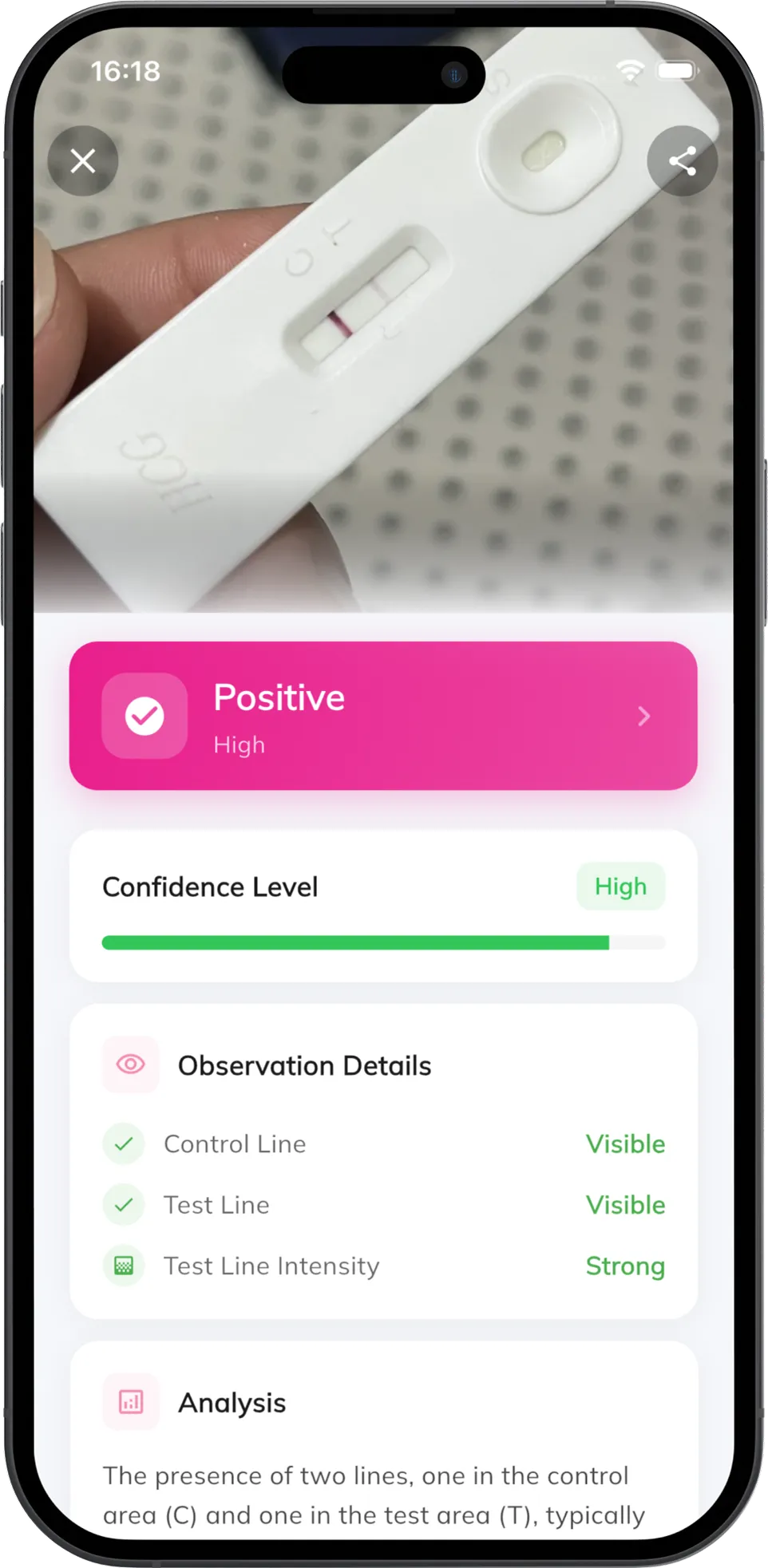
Pregnancy Test Checker + supports Clearblue tests and more than 11 other brands. You photograph the test stick, and the AI scanner reads the result and returns a confidence score in seconds. It handles faint-line detection where the second line is barely visible. All data stays on your device; nothing is uploaded.
For a broader look at what each Clearblue test format shows, the digital pregnancy test guide covers the full Clearblue digital range, including the plus/minus display and the word-result test. The Clearblue Early Detection guide covers the line-based test in the same range.
Frequently Asked Questions
Does the Clearblue weeks indicator show weeks pregnant or weeks since conception?
It shows weeks since conception. To get the gestational age your midwife uses, add roughly two weeks. A 1-2 reading means approximately 3-4 weeks pregnant. A 2-3 reading means 4-5 weeks. A 3+ reading means around 5 or more weeks pregnant by standard LMP dating.
Why did I get a 1-2 result but my period is several weeks late?
A late period doesn’t always mean conception was weeks ago. If you ovulated later than usual in that cycle, conception may have happened more recently than the calendar suggests. Urine dilution can also lower detected hCG and push the result into an earlier category. Your dating scan will give the accurate gestational age.
Is 3+ the highest result on the Clearblue weeks indicator?
Yes. The display shows only three categories: 1-2, 2-3, and 3+. The test measures hCG at two threshold points, producing three possible bands. It doesn’t track hCG as a continuous number, so it can’t distinguish between 5 weeks and 8 weeks pregnant.
Can the weeks indicator be wrong if I tested with dilute urine?
Yes. Testing with dilute urine lowers the apparent hCG concentration, which can shift the result toward an earlier category. Per Clearblue’s product instructions, first morning urine gives the most accurate weeks reading because hCG concentrates overnight and isn’t diluted by fluid intake during the day.
Should I use the weeks indicator to work out my due date?
Clearblue advises against using the weeks result as a clinical dating tool. It’s an estimate based on hCG thresholds with a stated 93% accuracy for conception timing. Your provider will calculate your due date from your LMP and confirm the precise gestational age at your dating scan. The due date calculator can give you an early estimate from your LMP.
If you have a line-based test alongside your digital and want a second read on the result, Pregnancy Test Checker + scans any supported test photo and returns a confidence-scored result. Everything stays on your device.
Sources
- Clearblue, Digital Pregnancy Test with Weeks Indicator, product page: https://uk.clearblue.com/pregnancy-tests/digital-with-weeks-indicator
- Clearblue, Weeks Indicator — Healthcare Professional Information: https://uk.clearblue.com/healthcare-professionals/pregnancy-tests/digital-with-weeks-indicator
- NHS, “You and your baby at 4 weeks pregnant”: https://www.nhs.uk/pregnancy/week-by-week/1-to-12/4-weeks/