Reverse due date calculator
Enter a due date to work backwards: the estimated conception date, the six-day fertile window around it, the notional first day of the last period, and how far along the pregnancy is today.
Updated October 4, 2026. Sources listed below.
Nothing you enter leaves this page. The result is an estimate for information only, not medical advice.
How the dates are worked out
A due date is built on a fixed convention: 280 days from the first day of the last menstrual period, which is the same as 266 days from ovulation and conception, assuming ovulation on cycle day 14. Running that backwards is arithmetic. Due date minus 266 days gives the estimated conception date; minus 280 gives the notional first day of the last period that clinics count gestational age from.
Conception itself is tied to ovulation, not to a single day of intercourse. In the Wilcox study of 221 women, every conception followed intercourse on one of the six days ending on ovulation day, because sperm can survive in the reproductive tract for up to five days. The calculator shows that six-day window rather than pretending to know a single date.
What it cannot tell you
It cannot pin conception to one day, and it inherits whatever uncertainty went into the due date you entered. It is for curiosity and planning, not for anything that needs certainty.
Sources
Frequently asked questions
How does a reverse due date calculator work?
It runs the standard dating rules backwards. A due date is set 280 days after the first day of the last period, or 266 days after conception, so subtracting 266 days from the due date gives the estimated conception date and subtracting 280 gives the notional last-period date.
How accurate is the conception date?
It is an estimate of ovulation day, not of a particular act. Conception can follow intercourse by up to about five days because sperm survive that long, which is why the calculator also shows the six-day fertile window ending on the estimated ovulation day, the window found in the Wilcox 1995 study.
My due date came from an ultrasound. Does that change anything?
No. Whatever method set the due date, the calculator assumes the same 280-day convention behind it. An ultrasound-dated due date usually gives a slightly better conception estimate than one from a remembered last period.
Does it store anything?
No. The calculation runs in your browser and nothing is saved or sent.
Get Boomba
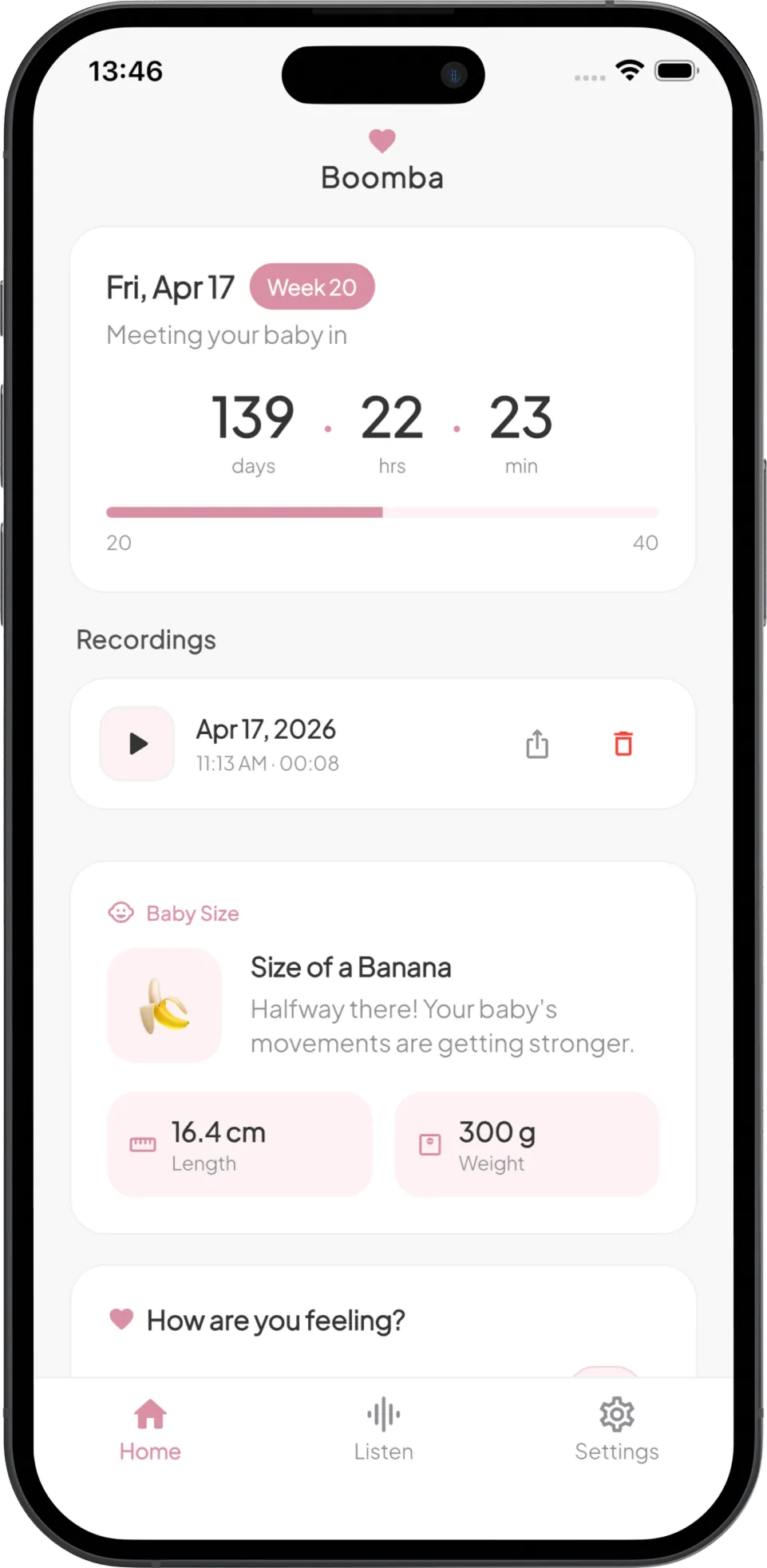
Boomba keeps a due date countdown alongside its listening and recording features. Available on Android today.
Boomba is coming to iOS soon. It is available on Android today. Thanks for letting us know you are interested, it helps us prioritise.