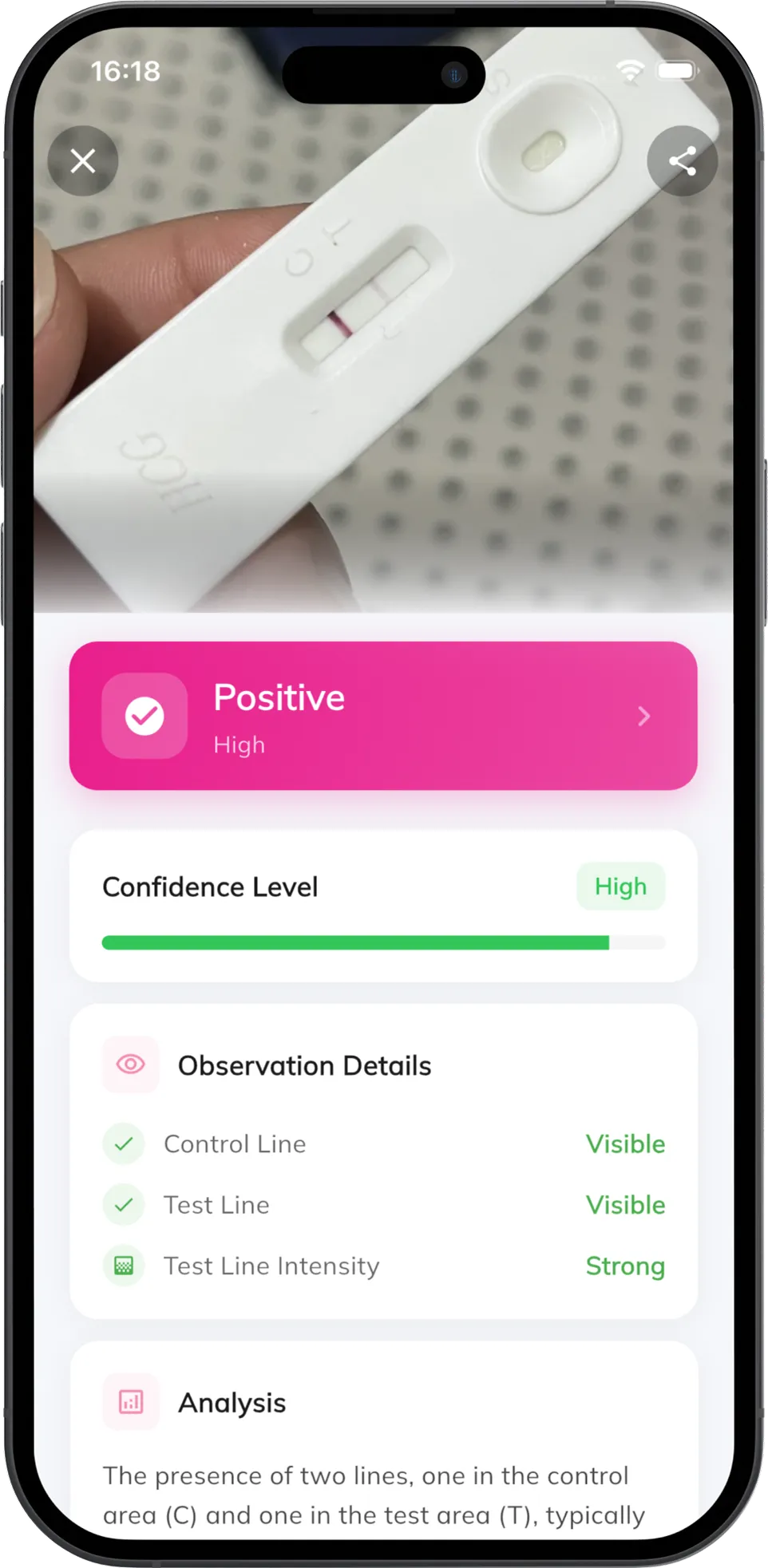
You took the test, set it down, and now there’s a very faint line you can only see if you tilt the stick toward the window. A faint line on a pregnancy test is one of the most searched phrases of the two-week wait, and it looks nothing like the bold stripe on the box. This guide covers how that line gets there, what the leaflets say about reading it, how it differs from an evaporation or indent line, and when to retest.
I spent two years photographing test strips before our first baby. Nothing here interprets your result, though: facts are linked to their source, and the person who confirms a pregnancy is your provider. This post belongs to our waiting and testing stage.
A faint line on a pregnancy test is a test line that has picked up color, but less of it than the control line. Manufacturers such as Clearblue and First Response state in their instructions that a colored test line appearing within the reading window counts as a positive result, however light, and that a provider should confirm it.
What a faint line on a pregnancy test actually is
Every home pregnancy test looks for one thing. The NHS puts it plainly: all pregnancy tests detect the hormone human chorionic gonadotrophin (hCG).
The strip itself is a wick. Urine travels along it, passes a test zone treated to react with hCG, then reaches a control zone that colors up whenever liquid has flowed through properly. First Response’s leaflet describes this: one pink line means the test is complete and was done correctly.
The control line gets its full dose of dye every time, which is why it’s dark. The test line only gets as much dye as the hCG in that sample pulls down. A faint line means a little dye landed there, a dark line means a lot, and both are the same chemistry at different concentrations.
The leaflets are blunt about faintness. Clearblue’s Early Detection leaflet says “It does not matter how faint or dark the lines are,” and First Response’s says two pink lines mean pregnant and “One line may be lighter than the other.” Both leaflets, in the same breath, tell you to confirm with your healthcare provider.
Why a faint positive pregnancy test line happens
Line darkness tracks how much hCG the strip met in that one sample, and early on there isn’t much to meet. The NHS notes that hCG starts to be produced around 6 days after fertilisation, and it only reaches urine once the embryo has implanted. In the Wilcox 1999 study in the New England Journal of Medicine, which followed 221 women and defined implantation by the first appearance of hCG in urine, implantation occurred 6 to 12 days after ovulation, with 84% on days 8, 9 or 10. A test taken in the days right after that meets very little hormone, and the manufacturers’ own data shows the effect. First Response’s leaflet reports that 76% of samples from pregnant women gave a positive result 5 days before the expected period, 96% at 4 days, and more than 99% from 3 days before onward. Clearblue’s Early Detection leaflet gives 77% at 6 days before the missed period, climbing to over 99% from the day the period is due.
So an early test that shows anything is showing it with a small amount of hormone. Beyond timing, 2 other things pull a line lighter.
Dilution. First Response’s leaflet warns that excessive fluid intake, including water, can dilute urine so that hCG isn’t detected properly, and recommends first morning urine when testing early because it generally carries the highest level.
Sensitivity. Tests are tuned to different thresholds. Clearblue’s UK Ultra Early leaflet states a sensitivity of 10 mIU/ml, while its US Early Detection leaflet states 25 mIU/ml, so two sticks dipped in the same cup can show different darkness because they’re built to flag different amounts.
The read-within-the-window rule, brand by brand
Every result on a line test has a shelf life, and it’s printed on the leaflet. Here are the official windows side by side.
| Test (official leaflet) | Wait before reading | Read by | After that |
|---|---|---|---|
| First Response Early Result | 3 full minutes | 10 minutes | “After 10 minutes, any change in the result should be disregarded” |
| Clearblue Early Detection (US) | 5 full minutes | 10 minutes | “Do not read results after 10 minutes” |
| Clearblue Ultra Early (UK) | 3 full minutes | 10 minutes | “Disregard any changes after this time” |
The NHS adds the general version: all tests are slightly different, so always check the instructions.
In practice this means 2 habits. Set a phone timer the moment the strip is wet and look when it goes off. Then photograph the stick inside the window, so the version you compare later is the version that counted, rather than the shadow you find when you fish the test out of the bin at lunchtime.
Faint line vs evaporation line vs indent line
Three different marks can sit in the test-line position, and they’re told apart by color, timing and texture rather than by darkness. The First Response article on faint lines draws the first boundary: a second line with color is a positive, while colorless or shadowy marks aren’t.
| Faint positive line | Evaporation line | Indent line | |
|---|---|---|---|
| Color | The test’s dye color (pink or blue), even if pale | Colorless, gray or shadow-like | Colorless; a groove rather than a tint |
| When it appears | Inside the reading window (3 to 10 minutes on the tests above) | After the window, as the strip dries | Any time, including before the test is wet |
| Does it count? | Per the leaflets, yes, however faint; confirm with a provider | The leaflets say to disregard changes after the window | No; it’s part of the strip |
An evaporation line is what the “after 10 minutes” rows in the previous table exist to rule out: as liquid leaves the strip, the place where the reagent sits can show as a dry ridge or a grayish streak with no dye in it.
An indent line is the same channel seen from the other direction: a thin stripe of reagent pressed into the paper, which under angled light can show as a slight dent even on an unused test. The three leaflets linked here don’t use the word “indent”; it’s forum vocabulary for a manufacturing feature.
Two checks separate the categories faster than staring does: hold the stick flat under daylight rather than tilting it under a bulb, and ask when you first saw the mark, inside the window or after you came back.
When and how to retest after a faint line
For a not-pregnant result, First Response’s leaflet says to retest if your period hasn’t arrived within a few days, and to call your doctor if a second test is also negative with no period. Clearblue’s leaflet says to wait at least 3 days before testing again. The NHS says to wait a few days and try again, and to speak to your GP if a second test is negative and your period hasn’t come.
For a faint positive, the leaflets skip straight to the provider. First Response’s wording is “You must see your doctor to confirm that you are pregnant,” and the NHS, while calling a positive home result almost certainly correct, still sends you to your GP or midwife.
If you want a second home test before that appointment, a few things keep the comparison fair.
- Use first morning urine when testing early, since First Response’s leaflet notes it generally carries the highest hCG level.
- Use the same brand and test type. A 10 mIU/ml strip and a 25 mIU/ml stick can’t be compared line for line.
- Time it, read it in the window, photograph it in the window, then stop looking at the old one.
- Know your days past ovulation. What DPO means explains the count, and the when-to-test calculator turns your cycle dates into a sensible test date.
What a faint line doesn’t tell you
A line test answers one question, above or below its threshold, and the darkness is a side effect of that.
It doesn’t tell you how far along you are. No strip test estimates weeks. Darkness depends on the sample, the sensitivity and the dilution, so the same morning can give a light line on one brand and a bold one on another.
It isn’t an hCG number. The leaflets state sensitivities such as 10 mIU/ml and 25 mIU/ml because the test is built to flag a threshold rather than measure. A faint line is a yes near the threshold rather than a value you can track.
It isn’t a statement about how a pregnancy is going. The leaflets are consistent that the test detects hormone and that your provider takes it from there. Anything about your own body belongs in that conversation.
That’s also why we don’t interpret readers’ photos: a guide can explain what a line is and quote the leaflets, and your provider tells you what yours means.
How Pregnancy Test Checker + helps with a faint line
The hard part of a faint line is the moment of reading: 3 minutes on a timer, a pale stripe, and a brain that wants to tilt the stick. Pregnancy Test Checker + is built for that moment.
You photograph the test inside its reading window, and the AI scanner reads the strip in seconds and returns a result estimate with a confidence score. Faint line detection is the core of it: the scanner is tuned to pick out a pale colored line that eyes under bathroom lighting struggle with. It supports more than 11 brands, including Clearblue, First Response and E.P.T.
The premium tier adds the pieces that matter for a retest. A line-by-line breakdown shows what the scanner saw at the control line, the test line and the overall pattern, unlimited scanning covers a second and third test, and test history keeps every in-window photo in order so you aren’t comparing dried sticks on a counter. Everything stays on your device, nothing is uploaded except the photo for analysis, and there’s no account.
The boundaries match this article’s. The app is an estimation tool for general information: it doesn’t confirm pregnancy, doesn’t measure hCG, doesn’t tell you how far along you are, and doesn’t replace your provider. It gives you a steadier read of the photo in front of you, and a record to bring to the appointment that settles the question.
Frequently asked questions
How common is a faint line on a pregnancy test?
Neither Clearblue nor First Response publishes a faint-line rate. Their leaflets do publish how often early samples test positive at all: 76% five days before the expected period for First Response Early Result and 77% six days before the missed period for Clearblue Early Detection, both above 99% from the day the period is due. Early lines are expected to be light because the hormone is only starting to appear in urine.
How many weeks pregnant am I with a faint line?
A line test can’t tell you. Darkness reflects how much hCG was in that one sample, the test’s sensitivity and how diluted the urine was, so it isn’t a dating tool. Dating comes from your provider, usually from your cycle dates or a scan, and no home strip test estimates weeks.
Will a faint line show if you’re not pregnant?
Per the First Response and Clearblue leaflets, a line that counts has the test’s dye color and appears inside the reading window; colorless or gray marks after the window are drying effects. First Response’s leaflet also notes that medications containing hCG can affect the result. If you’re unsure what you’re looking at, your provider can run a confirmatory test.
Does a faint line confirm pregnancy?
Manufacturers say no. First Response’s leaflet states that a positive result shows hCG was detected and that you must see your doctor to confirm, and the NHS, which calls a positive home result almost certainly correct, still routes you to your GP or midwife. Home tests are a screening step; confirmation and dating are your provider’s job.
Can you read a pregnancy test after 10 minutes?
The official leaflets say not to. First Response Early Result is read from 3 to 10 minutes with any later change disregarded, Clearblue Early Detection says do not read after 10 minutes, and Clearblue Ultra Early says to disregard changes after 10 minutes. A mark that only appears once the strip has dried is outside the result the test was designed to give.
If you’re holding a stick with a line you can barely see, photograph it inside the window and let Pregnancy Test Checker + give you a calm, confidence-scored read of it. Then take that photo and your questions to your provider for the answer that counts.
Sources
- NHS, “Doing a pregnancy test”, last reviewed 9 February 2022: https://www.nhs.uk/pregnancy/trying-for-a-baby/doing-a-pregnancy-test/
- First Response Early Result Pregnancy Test, official instruction leaflet (Church & Dwight): https://www.firstresponse.com/pdf/First-Response-Early-Result-Pregnancy-Test.pdf
- First Response, “Pregnancy Test with Faint Lines: Is it Positive or Not?”: https://www.firstresponse.com/en/articles-listings/faint-line-on-pregnancy-test
- Clearblue Early Detection Pregnancy Test, official instruction leaflet (US): https://www.clearblue.com/sites/default/files/wysiwyg/products/leaflets/450040-01_organized.pdf
- Clearblue Ultra Early Pregnancy Test, official instruction leaflet (UK): https://uk.clearblue.com/sites/default/files/wysiwyg/products/leaflets/2300433_03_0.pdf
- Wilcox AJ, Baird DD, Weinberg CR. “Time of implantation of the conceptus and loss of pregnancy.” New England Journal of Medicine 1999;340(23):1796-1799. https://www.nejm.org/doi/full/10.1056/NEJM199906103402304