Due date calculator
Estimate your due date from the first day of your last period, a known conception date, or an IVF transfer date. The rules follow ACOG's published method.
Updated October 2, 2026. Sources listed below.
Nothing you enter leaves this page. The result is an estimate for information only, not medical advice.
How the estimate is made
From the last menstrual period, the calculator adds 280 days, the traditional 40 weeks of Naegele's rule, then shifts the result by the difference between your cycle length and 28 days. From a conception date it adds 266 days. For IVF it follows ACOG's recommendation of transfer date plus 266 days minus the embryo's age at transfer.
The "today" figure is gestational age counted from the estimated first day of the last period, which is how clinics date a pregnancy. The progress bar shows that count against the 280-day reference.
What it cannot tell you
A due date is an estimate used to plan care. Your provider may revise it after an early ultrasound, and the birth itself can fall weeks either side of it. Nothing here is a reason to change plans or care without talking to your provider.
Sources
- American College of Obstetricians and Gynecologists. Committee Opinion No. 700: Methods for Estimating the Due Date. Obstet Gynecol. 2017;129(5):e150–e154.
- Jukic AM, Baird DD, Weinberg CR, McConnaughey DR, Wilcox AJ. Length of human pregnancy and contributors to its natural variation. Hum Reprod. 2013;28(10):2848–2855.
Frequently asked questions
How is the due date calculated from my last period?
By Naegele's rule: 280 days (40 weeks) from the first day of the last menstrual period. If your cycles are not 28 days, the calculator shifts the date by the difference, which is the standard adjustment described in ACOG Committee Opinion 700.
How is it calculated from a conception date or IVF transfer?
From a known conception date it adds 266 days. For IVF, ACOG recommends the transfer date plus 266 days minus the embryo age at transfer: 261 days for a day-5 transfer and 263 days for a day-3 transfer.
Will my baby arrive on the due date?
Usually not on the day itself. The length of pregnancy varies naturally by several weeks between people, as Jukic and colleagues found in a 2013 study that measured ovulation directly. The due date is a reference point for care, not a prediction of the birthday.
Can an ultrasound change the due date?
Yes. ACOG advises that an early ultrasound measurement is the most accurate way to establish or confirm gestational age, and a provider may revise the date if the scan differs enough from the menstrual estimate. This calculator cannot replace that.
Get Boomba
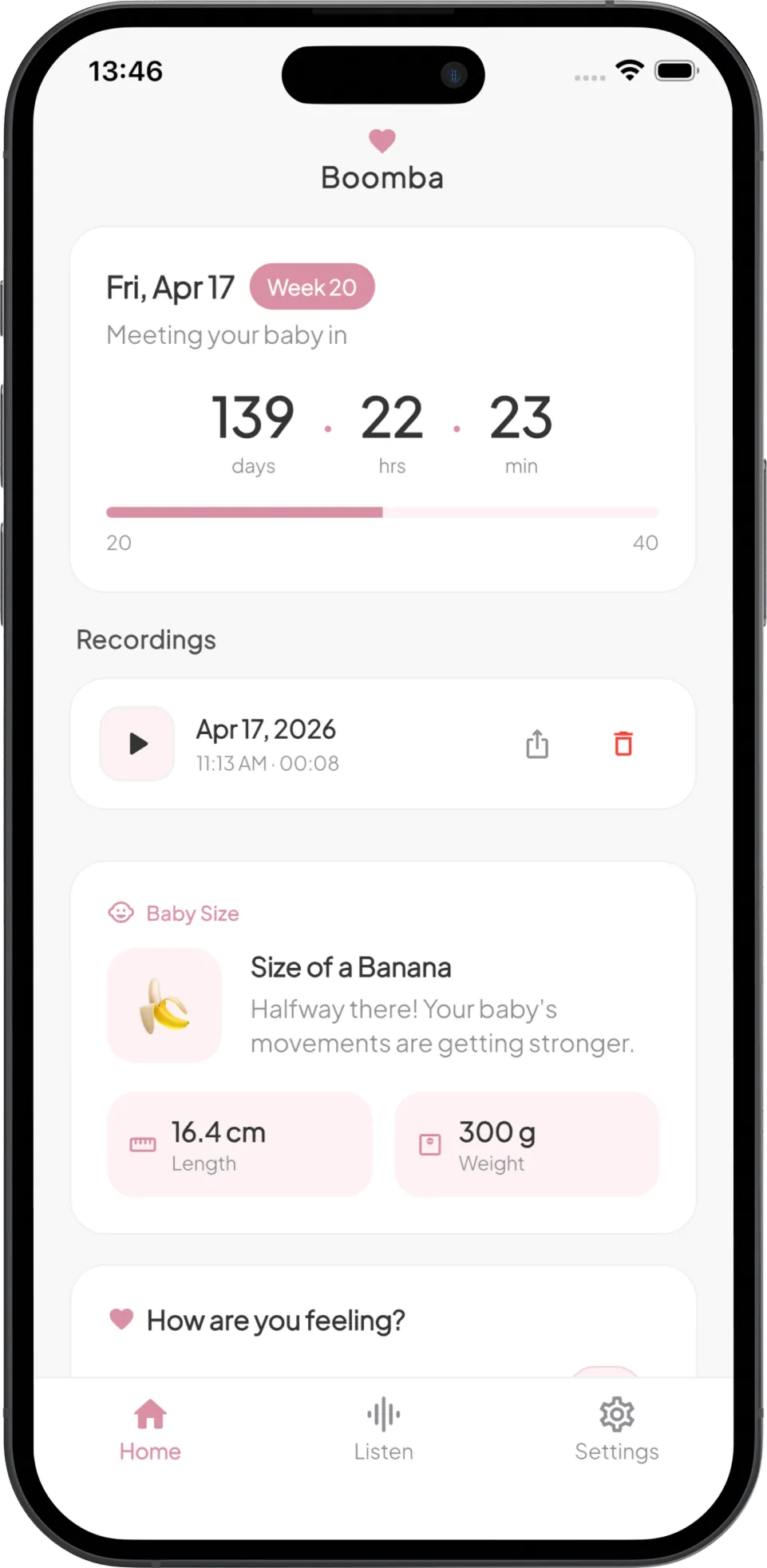
Boomba keeps a due date countdown and simple pregnancy tools alongside its heartbeat listening. Available on Android today.
Boomba is coming to iOS soon. It is available on Android today. Thanks for letting us know you are interested, it helps us prioritise.