The two-week wait has a way of slowing time down. You know roughly when ovulation happened, you’re counting days, and at some point you start asking: how many DPO can you actually test? Somewhere around 8 or 9 DPO the pull toward taking a test gets hard to ignore.
The answer depends on two things: when implantation happened in your particular cycle, and how sensitive the test is. This guide covers both, so you know what a result at any DPO actually means.
If you’re new to DPO tracking, what DPO means and how to count yours is a good place to start before reading on.
The earliest a sensitive home pregnancy test can detect hCG is around 10 DPO, though false negatives are common before 12 DPO. The NHS recommends testing from the first day of a missed period, typically around 14 DPO. Most people who are pregnant see a clear positive result by then.
What Test Sensitivity Means in mIU/mL
Every home pregnancy test measures hCG (human chorionic gonadotropin) in urine. Each test has a threshold, stated in mIU/mL, below which it returns a negative. The lower the threshold, the earlier the test can pick up a rising hCG level.
Home pregnancy tests measure hCG in urine, each with a stated sensitivity threshold in mIU/mL. First Response Early Result is rated at 6.3 mIU/mL by the manufacturer, making it one of the most sensitive over-the-counter options available. Clearblue Early Detection is rated at 10 mIU/mL. Standard strip tests typically fall at 20-25 mIU/mL. According to Wilcox et al., published in the New England Journal of Medicine in 1999, implantation occurs between 6 and 12 DPO, with the most common window being 8 to 10 DPO. Because hCG only rises after implantation, a test before 8-9 DPO will almost always be negative regardless of brand. Once implantation happens, hCG typically doubles every 48 to 72 hours, per ACOG. That doubling rate explains why a negative at 10 DPO on a 25 mIU/mL test can still turn positive by 12 DPO, and why more sensitive tests catch the rise a day or two earlier.
That 6.3-versus-25 mIU/mL gap matters in the early days of the TWW (two-week wait). A standard test at 10 DPO might read negative when a more sensitive test on the same urine would show a faint line.
The practical takeaway: if you’re testing before your missed period, the sensitivity number on the box matters more than the brand name.
When Implantation Sets the Testing Clock
A test can only detect hCG after implantation. Before the embryo attaches to the uterine lining, there’s nothing for a test to measure.
According to Wilcox et al. (1999), no implantations in that study were recorded before 6 DPO. The most common range was 8 to 10 DPO. A small number happened as late as 12 DPO.
This spread is why two people with identical cycle lengths can have very different DPO timelines for a positive result. Someone who implanted at 7 DPO and someone who implanted at 11 DPO might both be pregnant, but one person will see a line at 9 DPO and the other won’t see anything until 13 DPO.
hCG starts rising at implantation, but it takes a day or two to appear in urine in amounts detectable by a home test. That lag adds another layer: someone who implants at 8 DPO might not see a urine positive until 10-11 DPO, even on a 6.3 mIU/mL test.
The two-week wait article covers the full hCG timeline from ovulation onward, including data on when implantation typically happens and what follows.
Testing at Each DPO: What the Data Shows
Here’s a general picture of testing at different DPOs, based on implantation timing data from Wilcox et al. and manufacturer sensitivity thresholds. These are population-level patterns, not predictions for any individual result.
6-7 DPO. Implantation is possible at this stage but hasn’t happened for most people yet. Even on the most sensitive tests, positives here are rare. A negative at 6 or 7 DPO gives you almost no information.
8-9 DPO. For people who implanted at 6-7 DPO, hCG may have been rising for a day or two. A 6.3 mIU/mL test could show a very faint line. Most people testing at 8-9 DPO will see a negative.
10 DPO. A growing number of people who are pregnant will test positive here on a sensitive test. A negative on a 20-25 mIU/mL test at 10 DPO doesn’t rule out pregnancy, particularly if implantation was on the later side.
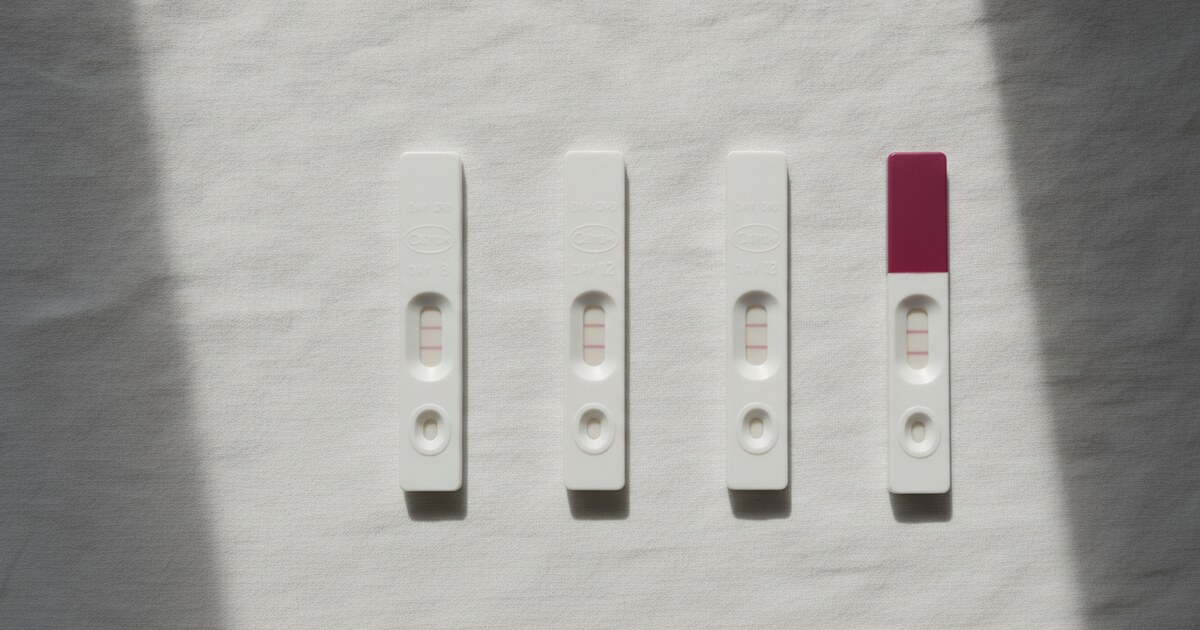
11-12 DPO. For most people who implanted in the 8-10 DPO window, hCG is now high enough to show on most test brands. Faint positives are common at this stage. A faint line on a pregnancy test at 11-12 DPO is a positive, even if it’s barely visible.
13-14 DPO. This aligns with a missed period for a typical cycle. The NHS advises testing from the first day of your missed period for the most reliable result. At 14 DPO, most tests will show a clear result for people who are pregnant.
Which Tests Detect Pregnancy Earliest
Test sensitivity varies significantly, and matching your choice of test to your DPO matters if you’re testing before a missed period.
First Response Early Result is rated at 6.3 mIU/mL per the manufacturer’s own leaflet. That puts it among the earliest-detecting options on the market. It’s a pink dye test with three windows: two lines means pregnant, one means not pregnant. Many people in TTC (trying to conceive) communities use it for serial daily testing across the TWW because of its low threshold.
Clearblue Early Detection is rated at 10 mIU/mL. The standard Clearblue Plus and the Clearblue Digital run higher, around 25 mIU/mL. Digital Clearblue variants need a stronger hCG signal than the early detection version, because the reader converts an analog line to a word result and requires more certainty to display one.
Most supermarket strip tests and bulk online packs are rated at 20-25 mIU/mL. They’re inexpensive for daily testing, but they’ll trail behind a 6.3 mIU/mL test by roughly 1-2 days in early pregnancy. At 10 DPO the difference between a 6.3 and 25 mIU/mL test can be the difference between a faint positive and a blank window.
The when-to-test calculator on this site helps you figure out the earliest realistic testing window based on your cycle dates and typical implantation timing.
How Many DPO Until a Negative Can Be Trusted
A negative result before 12 DPO is common even in pregnancies that go on to show a clear positive a few days later. hCG simply hasn’t doubled enough yet to cross the test’s threshold.
A few things make early negatives more likely:
- Later implantation (10-12 DPO instead of 8 DPO)
- A test with a higher sensitivity threshold (25 mIU/mL vs 6.3 mIU/mL)
- Diluted urine from testing later in the day rather than first morning
First-morning urine is more concentrated because fluid intake has been low overnight. Most manufacturers specify it in their instructions for early testing. Testing at midday after several glasses of water can dilute hCG enough to fall below the threshold, turning a potential positive into a blank window.
After 14 DPO, corresponding to a missed period, a negative on a sensitive test carries more weight. The waiting and testing journey hub has a fuller picture of what’s typical at each point across the TWW. If your period is late and tests remain negative past 14-16 DPO, talking to your provider is the right next step, as they can confirm with a blood test.
How Pregnancy Test Checker Helps Read Early Results
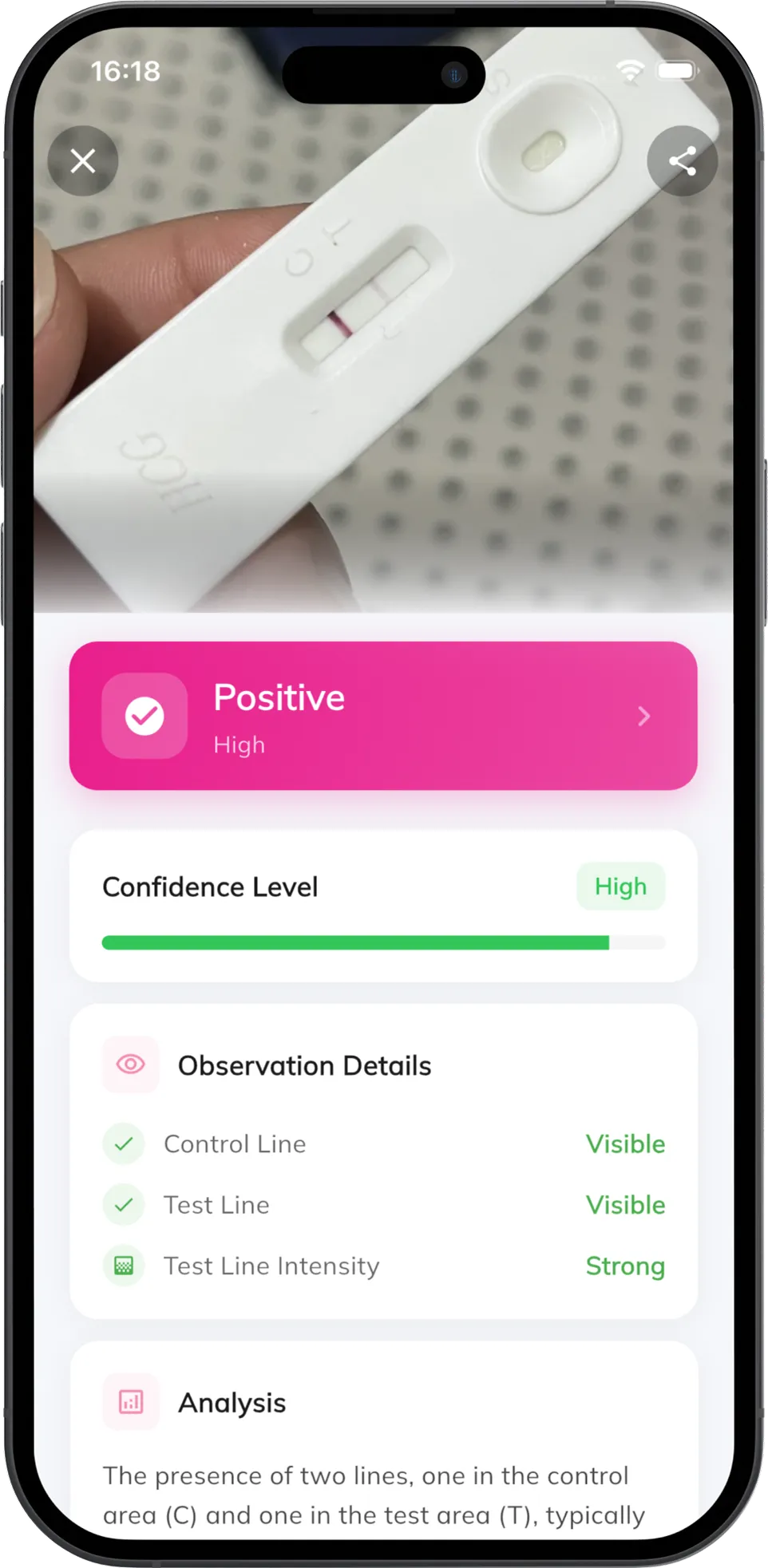
When you’re testing at 10 or 11 DPO, the line can be faint enough to make you genuinely unsure whether it’s there. Bad lighting, a shaky hand, staring at a white strip for too long: early testing is harder to read than a 14 DPO result.
Pregnancy Test Checker scans your test photo with your phone camera and assesses both the control line and the test line. It returns a confidence score and a line-by-line breakdown, so you’re not guessing under a bathroom light at 5am. The app works with First Response, Clearblue, and 11+ other test brands.
All analysis stays on your device. Nothing is uploaded or shared. The app is designed for informational use and estimation; it doesn’t replace a confirmed test read or a discussion with your provider.
You can read more about what it does on the Pregnancy Test Checker app page.
Frequently Asked Questions
Can you get a positive pregnancy test at 8 DPO?
It’s uncommon but possible. According to Wilcox et al. (1999), a small number of implantations happen at 6-7 DPO. For those cases, hCG may be high enough to show a faint line at 8 DPO on a 6.3 mIU/mL test. Most people who are pregnant will still see a negative at 8 DPO.
Is 10 DPO too early to test?
A negative at 10 DPO doesn’t rule out pregnancy. Some people do see a positive at 10 DPO on a sensitive test. Whether 10 DPO is “too early” depends on when implantation happened in that particular cycle, and there’s no way to know that from the outside.
Why did I get a negative at 11 DPO and a positive at 13 DPO?
hCG roughly doubles every 48-72 hours in early pregnancy, per ACOG. If hCG was just below the test’s threshold at 11 DPO, a few more doublings would push it above threshold by 13 DPO. That pattern is common when implantation happened in the 9-10 DPO range rather than at 8 DPO.
Does first-morning urine matter for early testing?
Most manufacturers specify it because it’s more concentrated. Testing later in the day, after drinking fluids, dilutes hCG in urine below the test’s threshold. On a 25 mIU/mL test at 10 DPO, that dilution can make the difference between a faint positive and a negative. First-morning urine is the most reliable sample for early testing.
If you’re in the early days of the TWW and want a second read on a faint or confusing result, Pregnancy Test Checker is available on the app page.
Sources
- Wilcox AJ, Baird DD, Weinberg CR. “Time of implantation of the conceptus and loss of pregnancy.” N Engl J Med. 1999;340:1796-1799.
- NHS. “How soon can I do a pregnancy test?” nhs.uk
- ACOG Practice Bulletin No. 200: Early Pregnancy Loss. May 2018. acog.org
- First Response Early Result Pregnancy Test product information. firstresponse.com