Ovulation calculator
Enter the first day of your last period and your usual cycle length to estimate your ovulation day, six-day fertile window and next period.
Updated October 2, 2026. Sources listed below.
Nothing you enter leaves this page. The result is an estimate for information only, not medical advice.
How the estimate is made
The calculator uses the calendar method. It takes the first day of your last period, adds your usual cycle length to find the next expected period, then counts back 14 days for the estimated ovulation day. That 14-day figure is the assumed length of the luteal phase, the stretch between ovulation and the next period.
The fertile window shown is six days: the five days before ovulation and ovulation day itself. That is the span during which intercourse was followed by conception in the Wilcox, Weinberg and Baird study of 221 women published in the New England Journal of Medicine in 1995.
What it cannot tell you
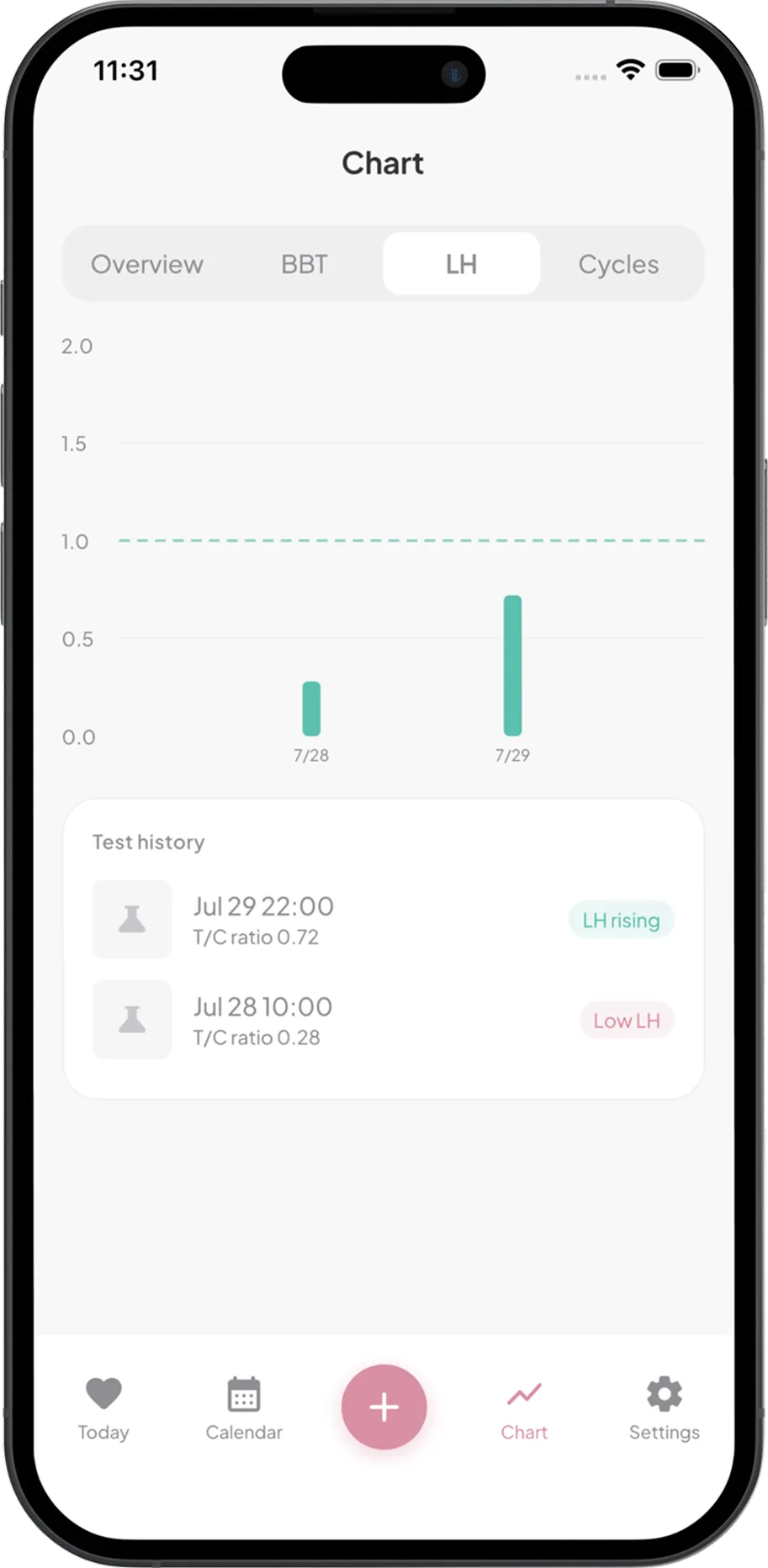
Dates alone cannot confirm that ovulation happened or exactly when. If your cycles are irregular, or you have PCOS, the estimate can be off by days or more. Signs from your body, such as an LH surge on a test strip or a temperature shift on a BBT chart, are the usual next step, and that is what the app is built for.
Sources
Frequently asked questions
How does the ovulation calculator work?
It applies the calendar method: ovulation is estimated 14 days before your next expected period, so ovulation day = first day of last period + (cycle length − 14). The fertile window is the five days before ovulation plus ovulation day, the six days on which conception is possible according to Wilcox et al. (1995).
Is the fertile window the same for everyone?
No. The 14-day luteal phase is an average assumption, and cycle length varies between people and between cycles. Irregular cycles, including with PCOS, make a calendar estimate much less reliable. Tracking signs such as LH test strips or basal body temperature gives a better picture than dates alone.
Can I use this to avoid pregnancy?
No. A calendar estimate is not a form of contraception and should not be relied on to prevent pregnancy.
Does the calculator store my dates?
No. The calculation happens in your browser and nothing is sent to a server or saved.
Get Ovulation Tracker
Ovulation Tracker goes further than a calendar: period logging, a BBT chart, an OPK strip photo reader and a PCOS mode for irregular cycles.