If you’ve spent any time in a trying-to-conceive forum, you’ve seen posts like “BFN at 9 DPO” or “faint line, 11 DPO” and wondered what the numbers are. The DPO meaning is simple: days past ovulation. It’s the ruler the whole community uses to describe where you are between ovulating and finding out, and once you can work out your own number, most of the other shorthand falls into place.
(One housekeeping note. DPO also stands for data protection officer in privacy law and days payable outstanding in accounting. If you arrived from one of those searches, everything below is the fertility meaning.)
DPO stands for days past ovulation. It counts the days since the egg was released, with the day of ovulation itself as 0 DPO. People trying to conceive use it because implantation and the hormone a pregnancy test detects both run on a clock that starts at ovulation, not at the first day of a period.
What DPO means, and why the count starts at ovulation
Cycle days (CD) start at the first day of your period. CD1 is day one of bleeding, and you count up from there. That works for tracking periods, but it’s a poor ruler for the second half of the cycle.
The problem is that ovulation moves. Cycle lengths differ from person to person and from month to month, and the day the egg releases shifts with them; the researchers who timed implantation describe it as “natural variability in the timing of ovulation” (Wilcox et al., JAMA 2001).
Two people both on CD20 could be 3 DPO and 8 DPO.
Counting from ovulation fixes that. Implantation, the start of hCG production and the day a test can turn positive are all measured from ovulation in the research, so the community adopted the same starting line.
The shorthand you’ll see next to DPO
| Shorthand | Spelled out | What it means |
|---|---|---|
| DPO | days past ovulation | Days since ovulation; ovulation day is 0 |
| TWW | two-week wait | The roughly 14 days from ovulation to the expected period |
| BFP / BFN | big fat positive / big fat negative | A positive or negative home test result |
| HPT | home pregnancy test | Any over-the-counter urine test |
| OPK | ovulation predictor kit | A strip that detects the LH surge shortly before ovulation |
| LMP | last menstrual period | The first day of your most recent period |
| CD | cycle day | Days since LMP; CD1 is the first day of bleeding |
So “BFN 9 DPO, testing again at 12” means a negative test nine days after ovulation, with a retest planned three days later.
How to count DPO (and the 0 or 1 question)
The counting itself is subtraction: today’s date minus your ovulation date. The part people argue about is what to call ovulation day.
Most calculators, including ours, call ovulation day 0 DPO. The day after is 1 DPO, and so on. The logic is that “days past” means full days elapsed, and on the day you ovulate, zero days have passed.
Some people start at 1 DPO on ovulation day instead. Neither convention is wrong, but they’re one day apart, and that one day matters when you’re deciding whether a 9 DPO test was really a 10 DPO test. When you compare notes with someone (or with a chart on a website), check which convention they use.
(IVF has its own version: days past transfer, written DPT or dp5dt for a day-5 embryo. After three rounds I can tell you the off-by-one argument exists there too.)
Pinning down ovulation day
The count is only as good as the date you start it from. Three common ways to fix that date, from loosest to tightest:
- Estimate from your cycle. The standard rule of thumb places ovulation about 14 days before the next period starts, so for a 30-day cycle, CD16 is the usual guess. Our ovulation calculator does this maths from your last period and cycle length. It’s an estimate, nothing more.
- Catch the LH surge with an OPK. An ovulation test turns positive on the surge of luteinising hormone that comes shortly before ovulation. A positive OPK tells you ovulation is close rather than marking the day itself; your brand’s leaflet states its typical gap. Many people count the day after the first positive as 0 DPO.
- Confirm with a BBT chart. Basal body temperature rises after ovulation and stays up. The shift only shows in hindsight, which is exactly what you want for DPO: it confirms the day the count started.
A worked example
Say your last period started on 1 October and your cycles run 28 days. The next period is expected on 29 October, so the estimated ovulation day is 15 October (14 days earlier). That’s 0 DPO.
- 16 October: 1 DPO
- 21 October: 6 DPO, the implantation window opens
- 25 October: 10 DPO, the earliest a positive is possible
- 29 October: 14 DPO, expected period
If an OPK had turned positive on 13 October, you’d probably move 0 DPO to 14 October and shift every line one day earlier. The when-to-test calculator builds this whole table for you from either an ovulation date or a last-period date, and tells you what DPO you’re on today.
What happens on the DPO timeline
This is what gives the number its meaning for testing. Everything here is timing and mechanism from published studies, and none of it says what any result means for you.
A home pregnancy test can’t turn positive until the embryo has implanted, because the hormone it detects, human chorionic gonadotropin (hCG), is made only after the embryo attaches to the uterine lining. The timing data comes from a US National Institutes of Health study that tested daily urine from 221 women trying to conceive. Among pregnancies that lasted at least six weeks, hCG first appeared, marking implantation, 6 to 12 days after ovulation, and 84% of them implanted on day 8, 9 or 10 (Wilcox, Baird and Weinberg, NEJM 1999).
In a 2004 study of 287 early pregnancies later confirmed as viable, blood hCG rose by a median 50% in one day and 124% in two, close to a doubling every two days (Barnhart et al., Obstetrics & Gynecology 2004). Together, that makes 10 DPO the earliest day a very sensitive test could detect anything, while the first day of a missed period, about 14 DPO, is when the NHS says most tests can be used.
| DPO | What the research places here |
|---|---|
| 0 | Ovulation. The egg is released and the count starts. |
| 6 to 12 | Implantation window (Wilcox 1999). hCG production begins at implantation. |
| 8 to 10 | Most common implantation days: 84% of pregnancies in the same study. |
| 10 | Earliest a positive is possible, and only if implantation happened early. |
| 12 | A reasonable first test for many people; hCG has had time to rise. |
| 14 | Expected period. NHS: most tests can be used from the first day of a missed period. |
| 21 | One week late. In Wilcox 2001, the highest possible test sensitivity reaches 97% here. |
How many DPO can you test?
The honest answer has three numbers.
10 DPO is the floor. Before implantation there’s no hCG to find, and implantation rarely happens before 6 DPO. Even an 8 DPO implantation needs a couple of days of hCG rise to reach a level a test can detect. A negative at 10 DPO proves very little; a positive is possible only if implantation was on the early side.
12 DPO is where many people take a first test. By then, most of the 8-to-10 DPO implantations have had two to four days of hCG rise behind them.
14 DPO, the expected period, is the reliable day. The NHS puts it plainly: you can carry out most tests from the first day of a missed period.
Even then there’s a ceiling. In a 2001 follow-up to the implantation study, 10% of pregnancies hadn’t implanted by the first day of the missed period, so the best possible sensitivity of any hCG test that day was 90% (Wilcox et al., JAMA 2001). One week later it reached 97%.
The same NHS page notes that a positive result is almost certainly correct, while a negative result is less reliable. That’s the whole case for testing later, or testing again. If a light line does show up, our guide to a faint line on a pregnancy test covers what the manufacturers say about reading one, and whatever you see, at whatever DPO, belongs in a conversation with your midwife or doctor.
How many DPO am I if I only know my last period?
Work backwards from the period you’re expecting, not forwards from the last one. Ovulation most often sits about 14 days before the next period, so:
- Add your usual cycle length to your LMP to get the expected period date.
- Subtract 14 days. That’s your estimated 0 DPO.
- Count from there to today.
Example: LMP 1 October, 32-day cycle. Expected period 2 November, estimated ovulation 19 October (CD19). On 29 October you’d be about 10 DPO.
Treat the answer as a range rather than a point. The 14-day gap is an average, not a law, and a confirmed ovulation date from an OPK or a BBT chart will always beat the estimate.
If your cycles are irregular enough that the expected period is a guess, the NHS suggests testing at least 21 days after you last had unprotected sex. That sidesteps the DPO count entirely.
How Pregnancy Test Checker + helps with the DPO count
Knowing your DPO tells you when a test is worth taking. Reading the test is the next problem, especially at 10 to 12 DPO when any line is likely to be light.
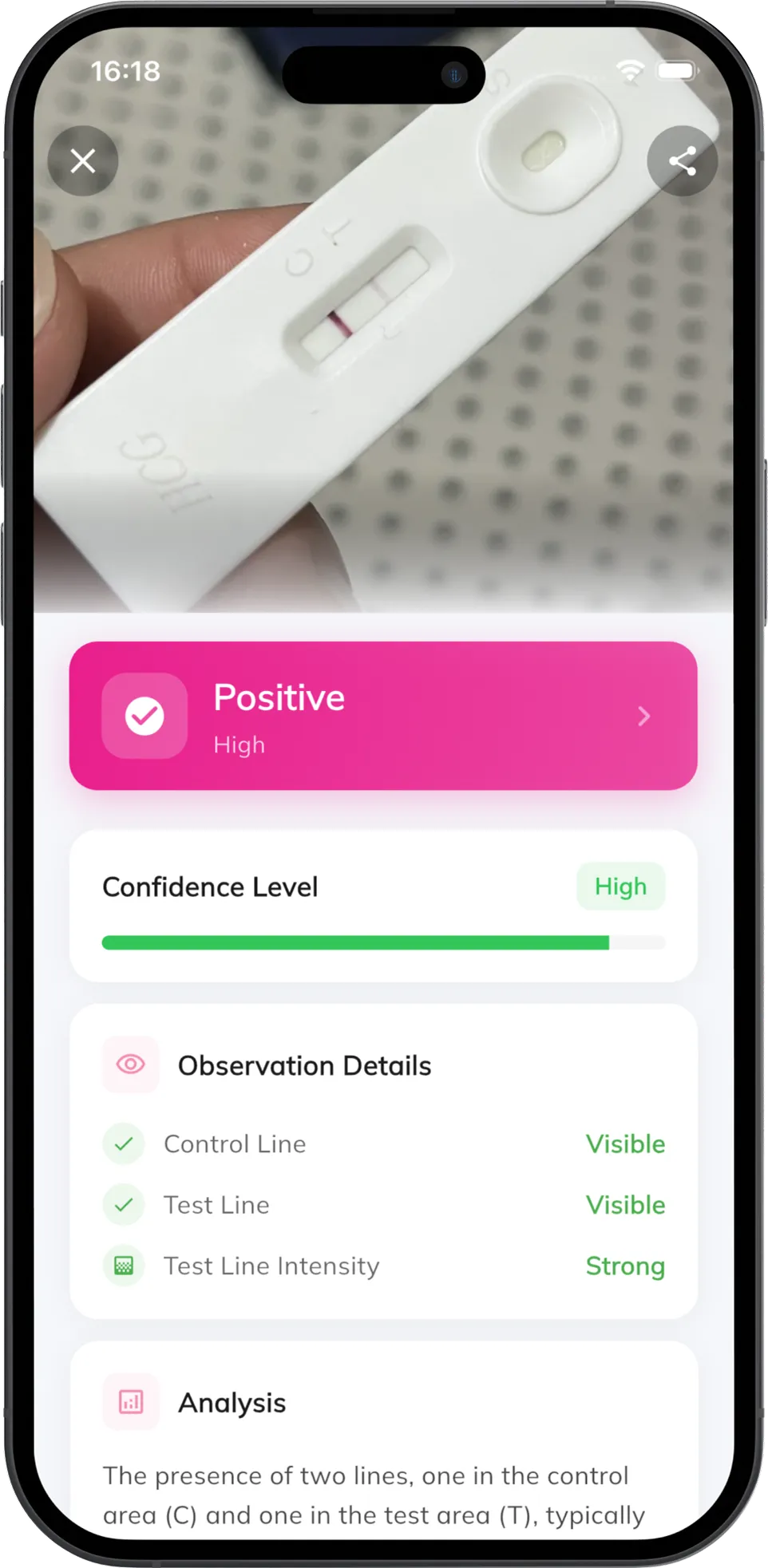
Pregnancy Test Checker + reads a photo of your test. Snap the strip, and the AI scanner returns a result in seconds with a confidence score. It’s built for the squint-at-it stage: faint line detection is the core feature, and it supports 11+ brands including Clearblue, First Response and E.P.T., so it reads the test you actually bought rather than a generic strip.
The photo is processed on your device and nothing leaves your phone. Premium adds a line-by-line breakdown (control line, test line, pattern), unlimited scans and a test history, so your 10, 12 and 14 DPO tests sit in one place instead of scattered through a camera roll.
Two honest limits. The app doesn’t measure hCG or tell you how far along you are; it’s an estimation tool for reading lines and it doesn’t replace professional advice. It also doesn’t read ovulation tests.
For those, and for pinning down 0 DPO in the first place, the Ovulation Tracker has an OPK photo reader for the LH surge and a BBT chart with ovulation confirmation.
Frequently asked questions
What does DPO mean in pregnancy?
DPO means days past ovulation: the number of days since the egg was released, counting ovulation day as 0. In trying-to-conceive communities it marks where you are in the two-week wait between ovulation and the expected period. The research on implantation and hCG is measured from ovulation, which is why DPO, and not cycle day, is the number people attach to a test result.
How do I calculate my DPO days?
Subtract your ovulation date from today’s date, using the OPK or temperature-shift date if you confirmed ovulation. If you only know your last period, add your usual cycle length to it, subtract 14 days for an estimated ovulation day, and count from there. The when-to-test calculator does both versions and shows your DPO today.
How many DPO for a positive pregnancy test?
Ten DPO is the earliest a positive is physically possible, because implantation happens 6 to 12 days after ovulation (most often 8 to 10) and hCG only starts after implantation. Twelve DPO gives the hormone more time to rise. The NHS says most tests can be used from the first day of a missed period, around 14 DPO, and even then about 10% of pregnancies haven’t implanted yet.
Is ovulation day 0 DPO or 1 DPO?
Most calculators, including the one on this site, count ovulation day as 0 DPO and the next day as 1 DPO, because “days past” means full days elapsed. Some people and forum charts start at 1. Both are in use, so when you compare your count with someone else’s, agree on the convention first; the difference is exactly one day.
Once you know your DPO, the waiting gets a schedule: 10 is the earliest, 12 is reasonable, 14 is reliable. Work out your dates with the when-to-test calculator, and when test day arrives, let Pregnancy Test Checker + read the line for you. Snap a photo and get a read in seconds, with faint line detection built in, and find the rest of the stage’s guides on the waiting and testing hub.
Sources
- Wilcox AJ, Baird DD, Weinberg CR. Time of implantation of the conceptus and loss of pregnancy. N Engl J Med. 1999;340(23):1796-1799. pubmed.ncbi.nlm.nih.gov/10362823
- Wilcox AJ, Baird DD, Dunson D, McChesney R, Weinberg CR. Natural limits of pregnancy testing in relation to the expected menstrual period. JAMA. 2001;286(14):1759-1761. pubmed.ncbi.nlm.nih.gov/11594902
- Barnhart KT, Sammel MD, Rinaudo PF, Zhou L, Hummel AC, Guo W. Symptomatic patients with an early viable intrauterine pregnancy: hCG curves redefined. Obstet Gynecol. 2004;104(1):50-55. pubmed.ncbi.nlm.nih.gov/15229000
- NHS. Doing a pregnancy test. Page last reviewed 9 February 2022. nhs.uk