IVF due date calculator
Enter your embryo transfer date and the embryo's age (day 3 or day 5), or your egg retrieval date. The calculator follows ACOG's method and shows your estimated due date and how far along you are today.
Updated October 4, 2026. Sources listed below.
Nothing you enter leaves this page. The result is an estimate for information only, not medical advice.
How the estimate is made
For a pregnancy from IVF the moment of fertilisation is known, so there is no need to estimate it from a last period. ACOG's Committee Opinion on estimating the due date sets the rule the calculator uses: due date equals the transfer date plus 266 days minus the embryo's age at transfer. A day-5 blastocyst gives transfer plus 261 days, a day-3 embryo transfer plus 263. An egg retrieval date stands in for ovulation, so the due date is retrieval plus 266 days.
"How far along" is reported as gestational age, counted from a notional first day of the last period 280 days before the due date, because that is how every clinic and chart measures pregnancy. It runs about two weeks ahead of the embryo's real age.
What it cannot tell you
The date is a planning estimate. Your clinic sets the official one, and the birth itself falls across a range of weeks. Nothing here changes any plan or care without your provider.
Sources
Frequently asked questions
How is an IVF due date calculated?
ACOG recommends dating an IVF pregnancy from the age of the embryo and the transfer date: the due date is the transfer date plus 266 days minus the embryo's age at transfer. For a day-5 blastocyst that is transfer plus 261 days; for a day-3 embryo, transfer plus 263 days. From an egg retrieval date, which stands in for ovulation, it is retrieval plus 266 days.
Does it matter if the transfer was fresh or frozen?
No. The rule uses the embryo's developmental age on the day it was transferred, so a frozen day-5 embryo transferred today is dated exactly like a fresh day-5 transfer today.
Why is an IVF due date considered more accurate?
Because the date of fertilisation is known rather than estimated from a last period. ACOG notes that for IVF pregnancies the due date should be set from the transfer or retrieval date and the embryo age, and generally not changed by later ultrasound measurements.
What does "how far along" mean here?
Gestational age is counted from a notional last-period date 280 days before the due date, the same convention clinics use. It is about two weeks more than the embryo's actual age.
Get Boomba
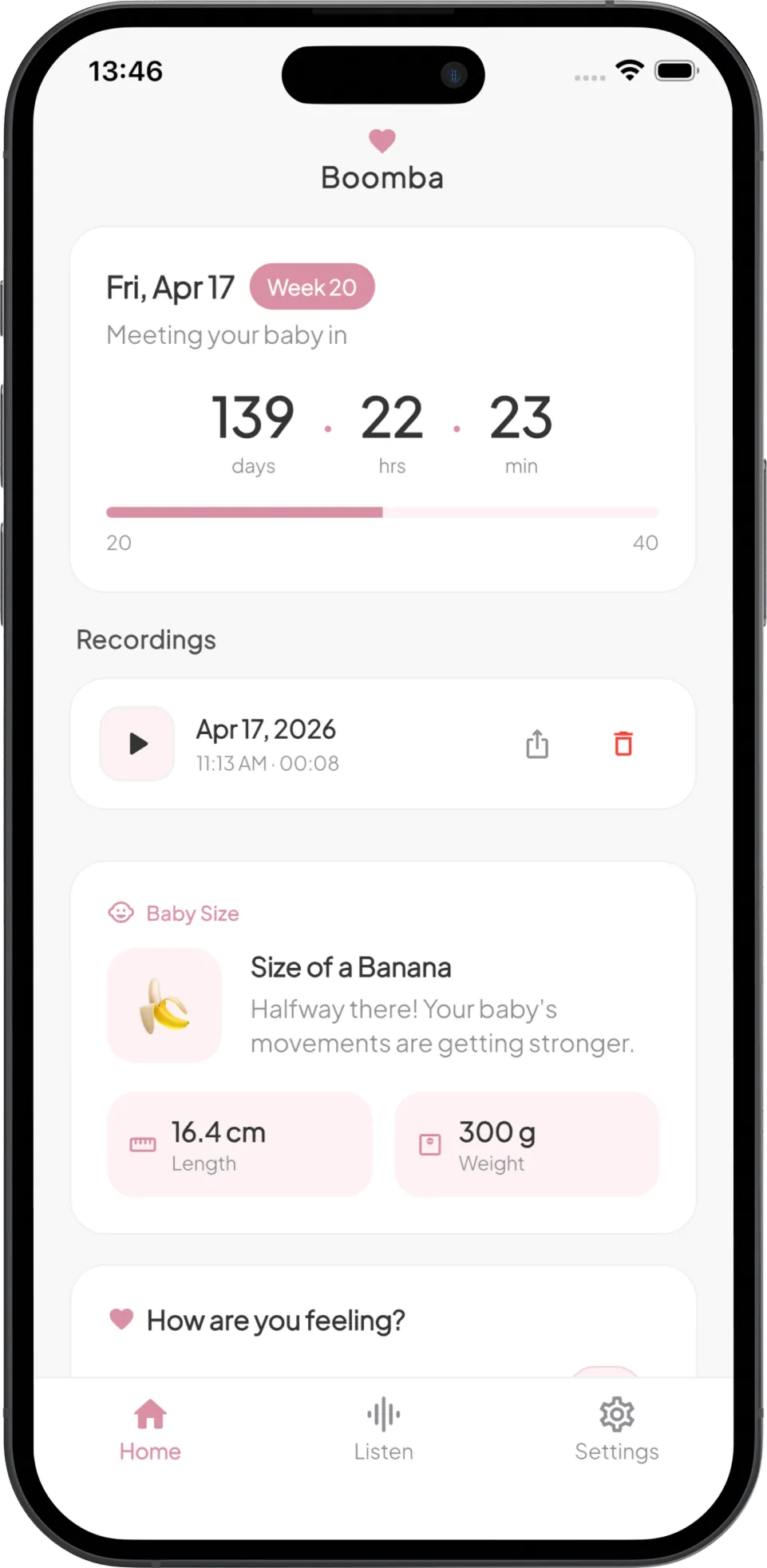
Boomba keeps a due date countdown alongside its listening and recording features. Available on Android today.
Boomba is coming to iOS soon. It is available on Android today. Thanks for letting us know you are interested, it helps us prioritise.