You take the test, set it flat, and come back a few minutes later to find a faint impression where the test line should be. If you’re asking whether that’s an indent line on a pregnancy test, you’re in good company during the two-week wait. The mark has no obvious color: just a faint groove in the test area, visible enough to notice, not clear enough to read.
What an indent line is, why it forms, and how to tell it from a faint positive are all straightforward once you understand how the test strip works.
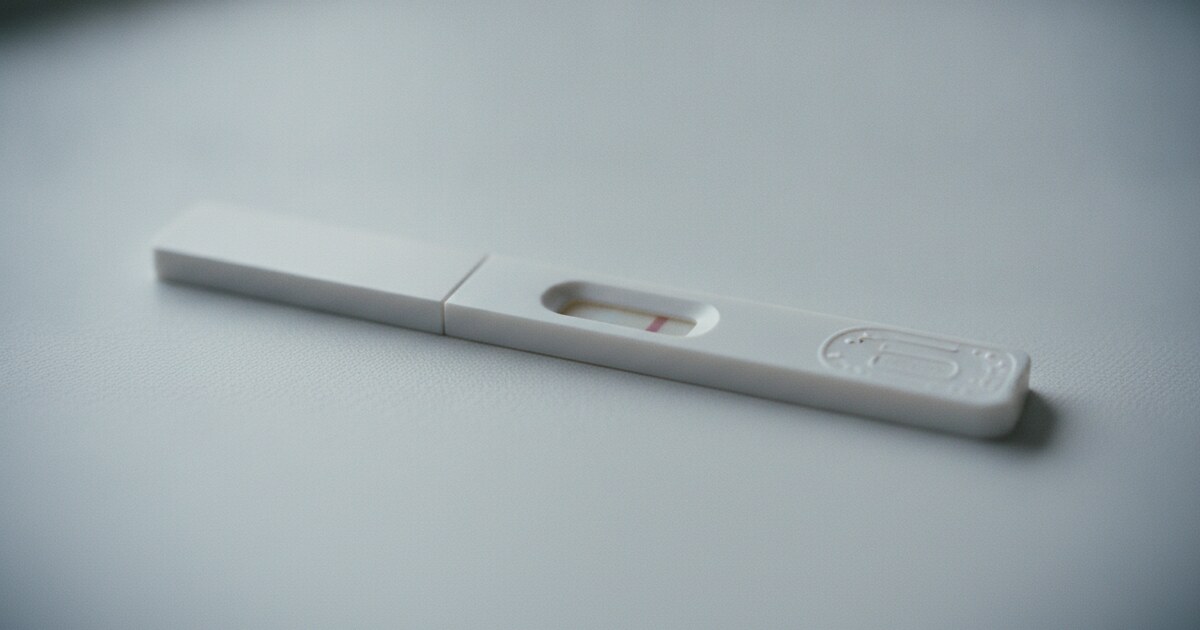
An indent line on a pregnancy test is a colorless groove in the strip where the test line would appear if hCG were present. Every test has this groove as part of its manufacturing. A true positive has visible color (pink or blue) and develops within the manufacturer’s reading window, typically 3 to 10 minutes.
What Is an Indent Line on a Pregnancy Test?
A lateral flow pregnancy test strip has two fixed antibody regions built into the nitrocellulose membrane: the control line zone (C) and the test line zone (T).
The C zone reacts with any urine passing through it, confirming the test ran correctly. The T zone only shows visible color when hCG (human chorionic gonadotropin) molecules bind to the antibodies embedded there and trigger a dye reaction. Without hCG, the T zone stays colorless.
Both zones are physical grooves in the membrane. They’re there whether or not hCG is present, which is where the indent comes from.
A lateral flow pregnancy test contains two fixed antibody zones built into the nitrocellulose membrane during manufacturing: the control line zone (C) and the test line zone (T). The C zone reacts with any urine flowing through it, confirming the test ran correctly. The T zone only shows visible color when hCG binds to the antibodies there and triggers a dye reaction. Without hCG, the T zone remains colorless, but the physical groove is still present as a structural feature of the strip. When urine flows through the membrane and the test begins to dry, liquid can pool in the T groove as it evaporates. The T groove holds only colorless fluid when hCG is absent, so what becomes visible is the groove catching light or holding a thin film of dried residue. According to the NHS guidance on doing a pregnancy test, all home pregnancy tests work by detecting hCG. The indent exists independent of any hCG reaction.
The short version: you’re seeing the slot where a positive would appear, not the positive itself.
Why Blue Dye Tests Show the Indent More
Not every test makes the indent visible. Blue dye tests are the most common source of indent line confusion, and the reason is the dye chemistry itself. The blue dye molecule is heavier than the dye used in pink dye tests. As the strip dries, the blue dye tends to migrate back along the nitrocellulose and collect in the T groove, creating a faint blue-gray shadow that can look like the palest possible line in strong light or in a photograph.
Pink dye tests (First Response Early Result, widely known as FRER, being the most commonly recommended) use a lighter dye that migrates far less. On a pink dye test, the indent groove is usually invisible without extreme lighting. Trying-to-conceive (TTC) communities consistently point to pink dye tests when an early result is expected, partly because the indent is much less of a visual issue.
Strip sensitivity plays a role too. Tests that detect hCG at 6 mIU/mL rather than the standard 25 mIU/mL carry a denser layer of antibodies in the T zone. That denser deposit can make the groove slightly more pronounced to the eye.
Situations Where an Indent Gets Mistaken for a Positive
A few specific circumstances make indent lines especially easy to misread.
Testing very early. At 8 or 9 days past ovulation (DPO), hCG levels are still very low even if a pregnancy has begun. At the same time, the strip’s T groove is fully formed and visible on a blue dye test. The result can be a strip with a clear C line and a faint, colorless shadow in the T position that looks almost like something.
Leaving the test to dry past the window. The reading window exists because the antibody reaction is time-limited. Once a test dries beyond that window, evaporated fluid leaves a thin residue across the strip, including in the T groove. A test read at 20 minutes instead of 3 will often show a shadow that wasn’t visible during the valid window.
Photographing under harsh or angled light. A bright bathroom light held at an angle picks up the groove’s surface texture and renders it as a distinct line. The same mark is invisible in flat natural daylight.
Edited or contrast-boosted photos. TTC forums are full of brightened test photos where every groove becomes a line. If a mark is only visible after editing, it’s not a valid read.
Indent Line vs Faint Positive: The Key Differences
Color. This is the clearest distinction. An indent has no color. It shows as a shadow, ridge, or slight depression in the strip material. A faint positive has color, even a very pale one. On a pink dye test, the earliest positive shows some pink or rose tint when held to daylight. On a blue dye test, a true positive is blue or gray-blue with actual pigment, not just reflected light from the groove.
When it appears. A true positive develops within the manufacturer’s reading window. Clearblue’s instructions say to ignore any result changes after 10 minutes. First Response’s guidance says to read the Early Result test at 3 minutes and not to rely on changes after 10 minutes. An indent typically becomes more visible as the test dries past the window, not during it.
How it changes as the test dries. Photograph the test right when the reading window closes. Check it again after 30 minutes. A faint positive is already there at the window and doesn’t intensify much further as the test dries. An indent often deepens or becomes more distinct over time, because evaporating liquid deposits more residue in the groove.
Which brand you’re using. If you used a blue dye test and you’re uncertain, running a pink dye test on first morning urine can give a clearer picture. The different dye chemistry makes it easier to judge whether any tint is genuinely present.
For a side-by-side look at colorless marks and true faint positives, the evaporation line vs faint positive guide covers both categories in detail.
The Reading Window Is the Rule
Every test manufacturer sets a reading window because the chemical reaction has a defined lifespan. hCG binds to the T zone antibodies and generates color within a few minutes. After that, the strip begins to dry and drying creates artifacts: evaporation residue, more visible indent grooves, and surface marks that weren’t there during the valid read period.
Clearblue’s instructions say to ignore changes after 10 minutes. The NHS guidance on pregnancy testing recommends following the instructions for the specific test and checking results at the right time. Reading outside the window is the single most common reason people mistake an indent for a positive.
The practical habit is to set a timer the moment you lay the test flat. Read at the time the instructions specify. If nothing is visible then, set it aside. Don’t photograph it under different lighting 20 minutes later and compare it to forum photos.
If you’re not sure when in your cycle to test in the first place, the when-to-test calculator works through timing based on your last period and cycle length. The DPO meaning guide explains when hCG typically becomes detectable and why testing earlier than the right window often produces unclear results.
How Pregnancy Test Checker + Can Help
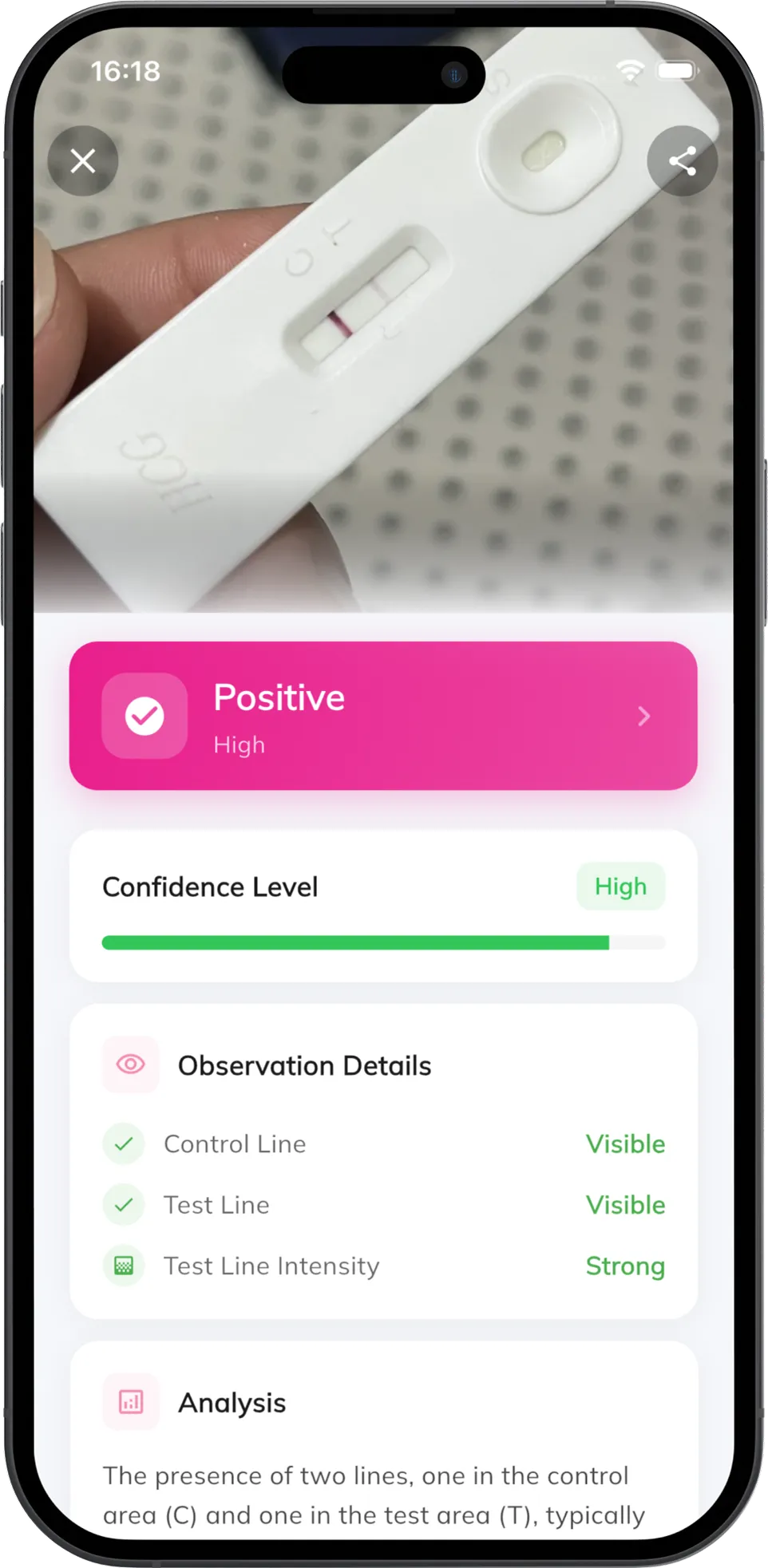
Pregnancy Test Checker + scans a photo of your test and reads the result with a confidence score, giving a line-by-line breakdown of what the scan detected in the control region and test region. If you took a photo within the reading window and you’re still unsure whether any color is present in the T zone, the app’s analysis gives a second perspective on the same image.
The app recognizes 11+ brands including Clearblue and First Response. It includes faint line detection. It doesn’t measure hCG and is described as an estimation tool rather than a clinical device. Everything stays on your device with no account required and nothing uploaded to a server.
The scan is most useful for photos taken during the valid reading window, which is precisely the situation an indent line question comes from. Pregnancy Test Checker + reads the T region for you and flags whether the scan picks up any color there.
Frequently Asked Questions
Can an indent line have any color?
An indent line is colorless by definition. If there’s any pink or blue tint, even a very pale one, the mark may be a faint positive rather than a structural indent. Colorless lines that only become visible as the test dries outside the reading window are the classic indent presentation. Color is the key distinction.
Do all pregnancy tests have indent lines?
Yes. Every lateral flow pregnancy test has a T line groove built into the strip during manufacturing. Whether you can see it depends on the dye type, the strip’s antibody density, and how the test dried after use. Blue dye tests make the indent visible far more often than pink dye tests.
I saw a mark on a blue dye test outside the reading window. Should I retest?
If the mark appeared after the reading window closed and has no color, running a pink dye test on first morning urine is the most straightforward next step. Pink dye chemistry makes it easier to judge whether any tint is genuinely present. This is what manufacturer instructions and TTC testing guides consistently suggest when a blue dye result is ambiguous.
How is an indent line different from an evaporation line?
They describe related but slightly different things. An indent is the physical groove in the strip. An evaporation line is the colorless mark that forms when dried fluid collects in that groove. Both are colorless, both appear outside the reading window, and neither is caused by hCG. TTC communities often use the terms interchangeably. The faint line guide walks through the distinctions if you want a closer look.
Pregnancy Test Checker + scans your test photo and reports what the T line region shows, which is often the fastest way to settle whether you’re looking at a colorless groove or a genuinely faint line.