You carry the test out of the bathroom, tilt it toward the window, and squint. There’s something in that second line spot. It’s pale, maybe colorless, maybe the faintest blush of color, and you can’t tell if it counts.
This is one of the most searched questions in the two-week wait (TWW): is the line you’re seeing a faint positive or an evaporation line, sometimes called an evap line? Both appear in the exact same place on the test window. Both can be nearly invisible. The difference comes down to two things: color and timing.
Once you understand those two things, any strip test becomes a lot easier to read.
An evaporation line is a faint, colorless or gray mark left as urine dries on the test strip. It contains no hCG. A faint positive is a real result: the pregnancy hormone was detected, but at low concentration. The key difference is color. A faint positive carries a trace of pink or blue; an evap line looks gray or colorless.
What an Evaporation Line Is (and What a Faint Positive Is)
A pregnancy test strip has two zones: the control line (C) and the test line (T). A positive result forms when dye-tagged antibodies in the strip bind to hCG in your urine and collect at the test line zone, leaving a colored mark. The more hCG is present, the darker that mark.
An evaporation line forms differently. After urine travels across the strip and the test starts to dry, a faint ridge or residue sometimes settles in the test line zone. That residue has nothing to do with hCG. It’s a structural artifact of the strip material, not a dye reaction to the pregnancy hormone.
Both lines appear in the exact same place on the test window, which is why they’re so easy to confuse. The test line zone sits just below the control line on most strip tests. A faint positive forms there because a small amount of hCG triggered a partial dye reaction. An evaporation line forms there because urine left a physical trace as it dried. The physical location is identical; only the chemistry is different. Faint positives are more common when testing before a missed period because hCG levels are still low. According to the American College of Obstetricians and Gynecologists, hCG roughly doubles every 48 to 72 hours in the early stages of pregnancy. Testing one or two days earlier means less hCG in the urine and a lighter test line. Waiting another 48 hours before retesting often turns a confusing faint line into an unmistakable one.
The Two Signals That Separate an Evap Line From a Faint Positive
Color and timing are the two checks that matter most. You can run both before picking up the test for another look.
Color
A faint positive has color, even when the line is very light. On a pink dye test, the second line will be some shade of pink, from barely-there blush to a clear rose. On a blue dye test, it will carry some shade of blue.
An evaporation line has no color. It looks gray or colorless, and in certain light it can resemble a pale indent or watermark. If you hold the test under a bright light and still can’t see any pink or blue tint in that second line, that’s the evap line giveaway.
Timing
Every test has a reading window printed in its package insert, typically 3 to 5 minutes for most brands. Read within that window. Evaporation lines tend to develop after 10 minutes or more, once the urine on the strip has mostly dried.
A result you noticed at the 3-minute mark is far more reliable than something you spotted after leaving the test on the bathroom counter for 20 minutes. If you missed the reading window, that test can’t give you a reliable read. Use a fresh one.
Blue Dye vs Pink Dye: Which Makes It Easier?
The type of dye in your test affects how easy it is to distinguish a faint positive from an evap line.
Pink dye tests, including First Response Early Result, have a clearer contrast. On these, a true evap line looks gray or colorless. Any pink in the test zone means the dye reacted to something, which means the question becomes simply: is there any pink at all?
Blue dye tests, including Clearblue Early Detection and Clearblue Plus, are more prone to ambiguous lines. As the test dries, the blue dye can spread slightly, leaving a faint grayish-blue mark that carries some color but has no hCG behind it. This is why many people in the TTC (trying to conceive) community prefer pink dye tests when they’re testing early and expecting faint results.
If you’re using a Clearblue digital test or the Clearblue weeks indicator, none of this applies. Those tests show a word or a number rather than a line, so there’s nothing to interpret.
Reading Your Test Correctly
A few small habits cut the confusion significantly.
Test with first morning urine. Your first urine of the day is most concentrated after a full night without fluids. That means hCG is at its highest daily concentration. A line that’s invisible with afternoon urine can show up clearly in the morning.
Lay the test flat. Running the test with the result window facing up keeps urine migrating evenly across the strip. Tilting it can affect how the dye flows and where it settles.
Set a timer. First Response instructs reading at 3 minutes. Clearblue Early Detection says to read at 3 minutes and no later than 10. Check your specific test’s package insert, then follow those times exactly.
Read it once, in the window. A result seen at 5 minutes is the result. Coming back an hour later and seeing a faint line is almost certainly evaporation, not a late-forming positive.
Don’t disassemble the test. Pulling the casing apart to examine the strip directly changes the reading conditions. Any result you see that way isn’t valid.
How the Pregnancy Test Checker App Can Help
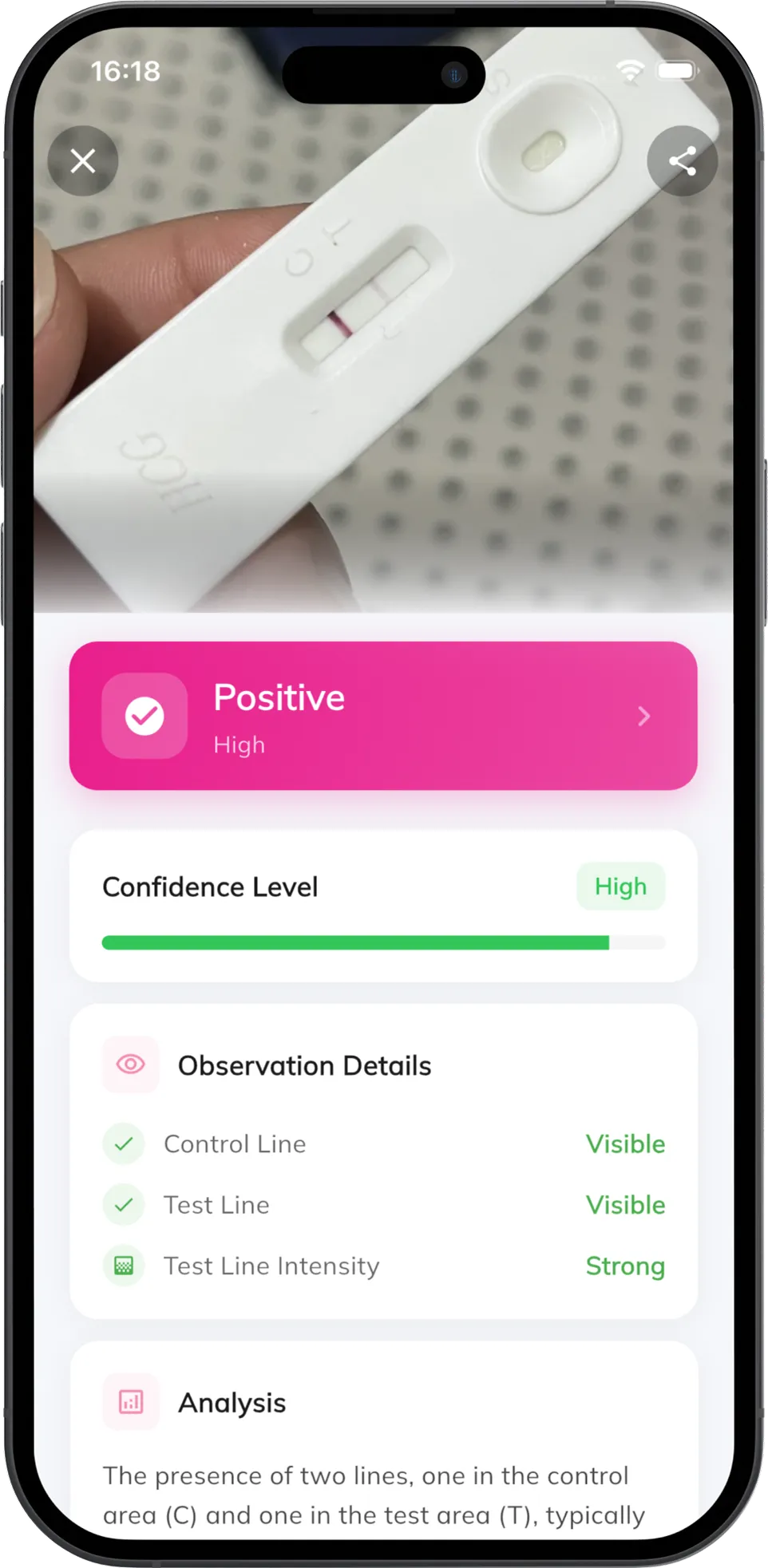
If you’ve photographed your test and the result still isn’t clear, the Pregnancy Test Checker + app can scan it for you. You take a photo of the test window; the app reads the line pattern using AI, including very faint lines, and gives you a result with a confidence score and a line-by-line breakdown showing the control line, the test line, and the pattern between them.
It supports Clearblue, First Response, E.P.T., and more than 8 other brands, and all processing happens on your device with nothing stored. The result comes with a clear disclaimer: it’s an estimation tool, not a clinical reading.
It won’t replace retesting or your provider’s guidance, but when you’re looking at a line you can’t call with your eyes, it gives you a second opinion based on the line pattern rather than your phone screen brightness.
When to Retest After a Confusing Result
If you’re not sure what you saw, the usual next step is a fresh test a couple of days later with first morning urine, which the First Response leaflet recommends when testing early because it generally carries the most hCG. The gap matters because hCG rises fast in early pregnancy: in the Barnhart 2004 cohort the median rise was 50% in one day and 124% in two days. The NHS adds that a negative result taken early is less reliable than a positive one, and that any result is for your GP or midwife to confirm.
A digital test removes the interpretation problem entirely. You get a word instead of a line. If you’re still inside the two-week wait, the when-to-test calculator turns your ovulation date into the earliest and most reliable test days, and the waiting and testing hub collects the rest of this cluster.
If you want to understand where you are in the two-week wait and map your DPO (days past ovulation) to testing windows, the DPO guide covers how to count and what each day means for test sensitivity. The faint line guide goes deeper on what causes a positive to look light and when a faint result is worth trusting.
If you’re looking at a confusing line right now, the Pregnancy Test Checker + can scan your photo and give you an AI-powered read in seconds. It supports Clearblue, First Response, and 11+ other brands. Download it free on iOS or Android.
Sources
- NHS. Doing a pregnancy test. nhs.uk
- First Response. Early Result Pregnancy Test, product instructions (reading window, “one line may be lighter than the other”, first morning urine when testing early). firstresponse.com
- Clearblue. Early Detection Pregnancy Test, instructions (reading window; “it does not matter how faint or dark the lines are”). clearblue.com
- Barnhart KT, Sammel MD, Rinaudo PF, Zhou L, Hummel AC, Guo W. Symptomatic patients with an early viable intrauterine pregnancy: hCG curves redefined. Obstet Gynecol. 2004;104(1):50-55. PubMed 15229000