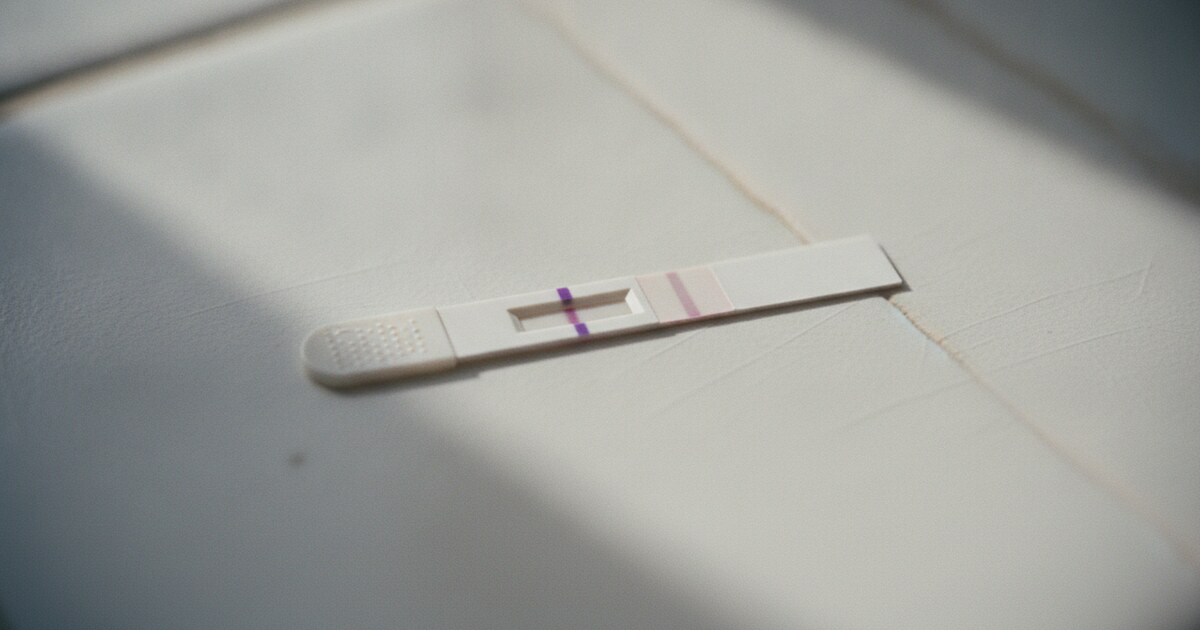
You test every day, and there’s always a faint second line on the strip. It’s clearly there, but it’s lighter than the control. Is a faint line on an ovulation test actually a positive?
OPKs (ovulation predictor kits) detect a different hormone from pregnancy tests, and the reading rules are completely different. Most of the confusion comes from applying pregnancy test logic to an OPK. Once you understand how the strip works, a faint line stops being confusing and starts being useful information.
This article covers why OPK lines behave differently from pregnancy test lines, what a faint test line means at each stage of your cycle, what a real positive looks like, and when persistent faint lines might be worth a conversation with your provider.
A faint line on an ovulation test is a negative result. Unlike a pregnancy test, where any visible line counts as positive, an OPK is only positive when the test line is as dark as or darker than the control line. A faint test line means LH is present at baseline levels but hasn’t reached the surge threshold yet.
Why OPK Lines Work Differently From Pregnancy Tests
A pregnancy test detects hCG, a hormone your body only produces during pregnancy. Because hCG normally isn’t present at all, any faint line on a pregnancy test counts as a positive result. There’s no baseline hCG to cause confusion. (For a deeper look at how faint lines on a pregnancy test work, the faint line on a pregnancy test guide covers it in detail.)
OPKs work on a different principle. They detect LH (luteinizing hormone), which your pituitary gland produces throughout your entire cycle. According to University of Iowa Health Care guidance on ovulation predictor kits, LH is always present in urine and its levels fluctuate throughout the month. The spike you’re looking for, the LH surge, is a sharp increase above your personal baseline. The strip isn’t checking whether LH exists. It’s checking whether LH has risen high enough to signal that the surge has started.
Because LH is always circulating, an OPK strip almost always shows some color on the test line. The result is only positive when that test line reaches or passes the control line. The control line represents the threshold concentration. When LH crosses it, the test line darkens to match or beat it. Any lighter result is still negative.
What a Faint Line on an Ovulation Test Actually Means
A faint line means your LH is detectable, but only at the background levels your body maintains between surges. It’s a negative result, and it’s what you’ll see on most days you test.
OPKs measure the ratio of your test line to the control line. The control line holds a fixed dye load representing a threshold LH concentration, roughly 20 to 25 mIU/mL for most standard strips, though each brand calibrates its own cutoff. During the follicular phase, baseline LH sits between about 1 and 18 mIU/mL in most people, which is why strips almost always show a faint second line rather than a completely blank result. When the pituitary gland fires the LH surge, typically 24 to 36 hours before ovulation, LH climbs to 25 mIU/mL and above, sometimes much higher, per a 2025 comparison study of ovulation tests published in PubMed Central. At that point the test line equals or darkens past the control line, and the result tips positive. A faint test line simply means LH is present at the level your body sustains on non-peak days. The result is negative until the test line clearly matches the control.
Seeing a faint line every day isn’t a problem. It’s the strip doing exactly what it should: picking up your baseline LH and giving you a reference point to compare against when the surge finally arrives.
How the Faint Line Changes as Ovulation Gets Closer
As ovulation approaches, your LH starts building. You’ll probably notice the test line gradually darkening over several days before it hits the positive threshold. That progression is useful: it tells you the surge is coming and that you should test more frequently.
The rise isn’t always gradual. Some people see a slow build over three or four days; others jump from a faint line to a clear positive almost overnight. Both patterns are normal. What matters is the comparison to the control line on the current day, not how much darker today’s strip is than yesterday’s.
Most strip manufacturer instructions recommend testing at the same time each day. Instructions typically note that LH is produced in the morning and appears in urine a few hours later, which is why late-morning to early-afternoon testing tends to catch the surge more reliably.
Taking a photo of each strip before discarding it gives you a visual record of the line progression. Comparing three or four days side by side shows the darkening pattern much more clearly than any single result in isolation.
Knowing roughly when to expect your surge helps you decide when to start testing. The ovulation calculator at Your Baby Journey estimates your fertile window from your last period date and average cycle length, which narrows down the days worth watching most closely.
What a Positive OPK Result Looks Like
A positive OPK tends to be unmistakable once you’ve seen one. The test line looks as dark as the control line or clearly darker. Both lines appear bold. If you’re squinting and unsure, the result is likely still negative: a true positive doesn’t usually require a judgment call.
Per University of Iowa Health Care guidance on OPK use, ovulation typically follows within 24 to 36 hours of the first positive test. That window is the core reason for timing intercourse around a positive result.
Some people see a strong positive for just one day; others hold it for two or three days as LH peaks and then falls. The first positive in a series is the key data point. After the positive, LH drops back and the strip returns to faint over the following days, which confirms the surge has passed.
For context on counting days through your cycle and how DPO (days past ovulation) fits into where you are after the surge, the DPO meaning guide walks through the calculation.
When Consistently Faint Lines Might Mean Something Else
Most people find their surge within a week or two of starting to test, as long as they start at the right point in their cycle. But some people test for multiple cycles without ever seeing a clear positive. A few reasons are common.
Starting too early is the most frequent cause. If you begin testing on day 6 of a 32-day cycle, you might spend ten or more days in faint-line territory before the surge even approaches. Most strip instructions include a chart for calculating a start date based on your shortest cycle length.
PCOS (polycystic ovary syndrome) is a different issue. It’s associated with chronically elevated LH levels, which can make strips show a near-positive line for several days at a time without a true surge occurring. NHS guidance on PCOS notes that irregular cycles are a hallmark of the condition, and OPK results can be harder to interpret as a result.
If you see several consecutive days of consistently strong-but-not-quite-positive readings, or what look like multiple positives in a single cycle, that pattern is worth discussing with your provider. It’s not a situation to troubleshoot alone.
How to Read Your Strip Accurately
A few habits make OPK reading more consistent across cycles.
Compare to the control line, not to yesterday’s strip. The only question that matters is whether today’s test line is as dark as the control line. How it compares to the strip from two days ago is secondary.
Read within the manufacturer’s stated window. Most strips specify a result window of 3 to 10 minutes after dipping. A line that appears after the stated window may be an evaporation line rather than a true result, and it doesn’t count.
Follow the sample instructions on the specific brand you’re using. Some strips recommend avoiding first morning urine; others specify it. Highly diluted urine from excessive fluid intake can affect the reading. What matters is following the instructions that came with your particular strip.
Photograph each strip before discarding it. When you can look back at four or five days of strips in one view, deciding whether today’s is genuinely positive becomes much easier than relying on memory.
How Ovulation Tracker Helps
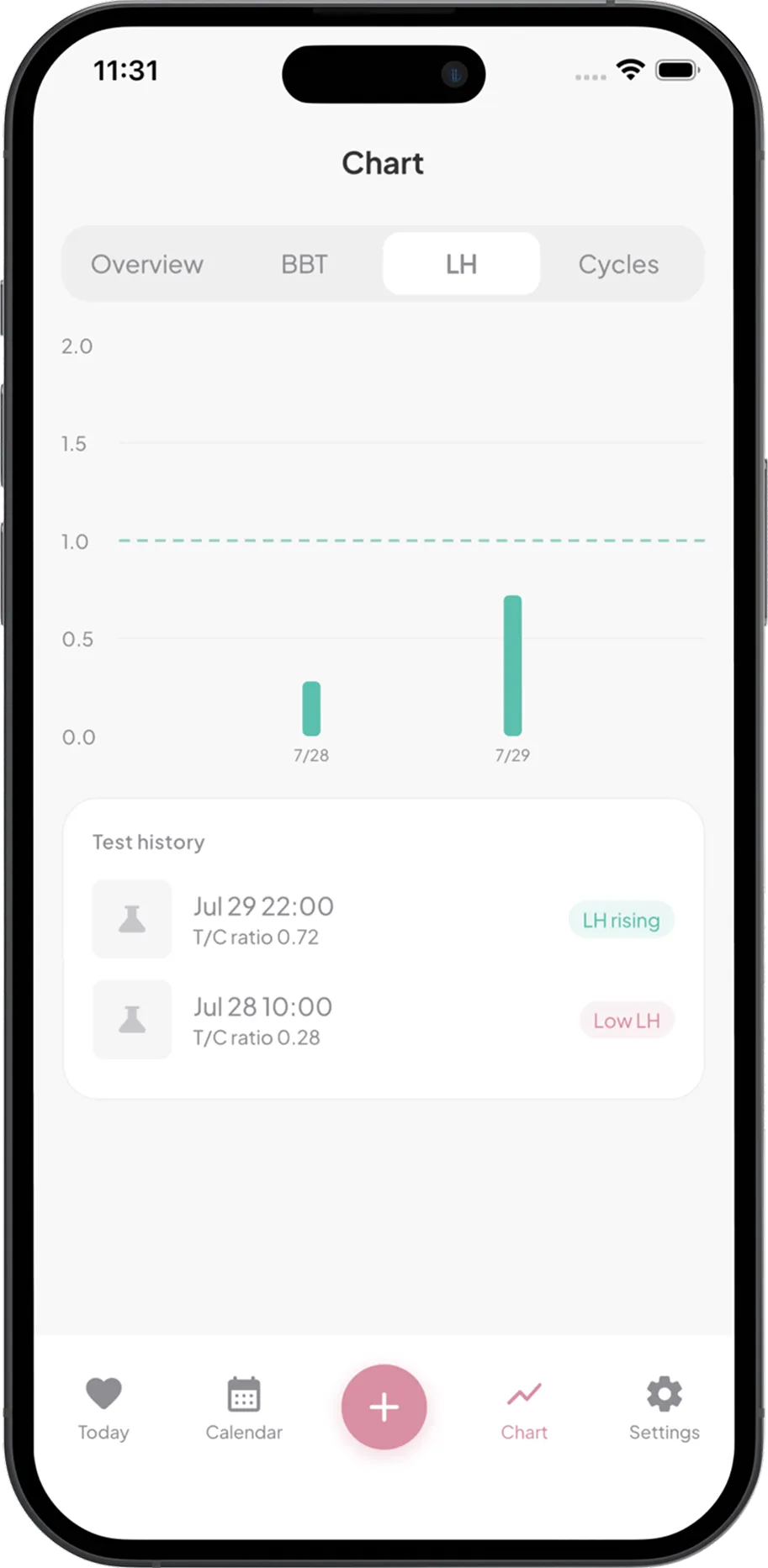
Reading strip intensity by eye is genuinely difficult. Lighting conditions, phone screen brightness, and how long you’ve been staring at the strip all affect the call. The Ovulation Tracker: PCOS Log app takes some of that guesswork out of the process.
It has an OPK reader built in. You photograph your strip and the app analyzes the test-to-control line ratio to detect the surge automatically. Your data stays on your device; nothing is uploaded or shared externally.
If your cycles are irregular or you’ve been told you have PCOS, the app includes a PCOS mode for logging your cycle in a way that accounts for variable cycle lengths and irregular patterns. It also tracks your BBT chart and logs your fertile window once your cycle history builds up.
You can find the Ovulation Tracker on the journey hub for trying to conceive, along with the other tools for that stage.
Tracking OPK results gets clearer once the ratio-based reading rule clicks. If reading strip intensities by eye isn’t giving you reliable answers, the Ovulation Tracker app’s built-in OPK reader photographs your strip and analyzes the test-to-control ratio automatically, so you’re not left guessing whether two lines actually match.
Sources
- University of Iowa Health Care. “Ovulation Predictor Kits (OPK).” https://uihc.org/educational-resources/ovulation-predictor-kits-opk
- “Comparison of two ovulation tests to predict timing of the late follicular phase for menstrual cycle research in premenopausal females.” PubMed Central, 2025. https://www.ncbi.nlm.nih.gov/pmc/articles/PMC12012743/
- NHS. “Polycystic ovary syndrome (PCOS).” https://www.nhs.uk/conditions/polycystic-ovary-syndrome-pcos/