You run the test at the right time, set it flat, and come back to find the test line not just positive but noticeably darker than the control line. If you’re in the two-week wait and you’ve seen this kind of result, the phrase you want is “dye stealer.”
The term isn’t in clinical literature. It came up in online trying-to-conceive (TTC) communities to describe something many people noticed and didn’t have a name for. What’s happening inside the strip has a clear mechanical explanation, and what a dye stealer does and doesn’t tell you about a pregnancy is straightforward once you understand how the chemistry works.
A dye stealer is when the test line appears darker than the control line on a home pregnancy test. It happens because high hCG levels saturate the test zone, capturing more dye than the control zone receives. It’s a TTC community term, not a clinical reading, and it doesn’t measure viability.
What Causes a Dye Stealer?
A lateral flow pregnancy test detects hCG (human chorionic gonadotropin) in urine. The strip holds two antibody zones: the control zone (C), which any urine activates to confirm the test ran, and the test zone (T), which only shows color when hCG binds the antibodies embedded there. The NHS guidance on doing a pregnancy test confirms that all home pregnancy tests work by detecting hCG. When hCG is present at low levels, the T zone shows a faint line. As hCG rises in early pregnancy, more antibody-dye complexes concentrate in the T zone. At the levels that produce a dye stealer, typically 500 to 1,000 mIU/mL or above, the T zone captures so many hCG-bound dye complexes that the C zone’s share is visibly reduced by comparison. Both zones draw from the same dye reservoir in the strip: one getting more means the other shows less. The result is a test line that looks clearly darker than the control line.
The two zones are competing for the same pool of dye-tagged antibodies flowing through the strip. At ordinary positive hCG levels, both the T and C zones get enough dye to look bold. At high hCG levels, the T zone takes a much larger share, and the C zone ends up paler than usual.
The word “stealer” captures this well: the test line appears to have stolen the dye from the control line.
When Does a Dye Stealer Typically Appear?
HCG rises steeply in the early weeks. For a standard positive to show at all, hCG needs to cross the test’s detection threshold, typically 25 mIU/mL for most brands. The concentrations that produce a dye stealer are much higher.
Based on community testing logs, dye stealers tend to appear most commonly somewhere between 21 and 28 DPO (days past ovulation), when hCG has had enough time to climb well above a basic positive threshold. For a breakdown of how to count DPO and why the number matters for testing, the DPO meaning guide walks through the calculation. You can also use the when-to-test calculator to figure out the earliest realistic testing window for your cycle.
Not everyone sees a dye stealer at the same point. HCG trajectories vary from person to person, and test sensitivity varies across brands. Some people get a dye stealer at 18 DPO; others don’t see one until several days later. Some never see a clearly darker test line and still have a straightforward positive on every test they take.
The key point: a dye stealer reflects high hCG relative to that specific test’s dye chemistry. It doesn’t translate to a meaningful clinical difference from any other positive.
What a Dye Stealer Does Not Mean
This is the part that trips people up, because TTC communities sometimes treat a dye stealer as a better kind of positive.
A dye stealer can’t tell you:
- Whether the pregnancy is in the uterus or elsewhere
- Whether hCG levels are rising at a healthy rate
- Whether the pregnancy will continue
- Whether you’re carrying more than one baby (twins do produce higher hCG on average, but single pregnancies also produce dye stealers, and not all twin pregnancies produce one)
HCG levels are interpreted by providers in the context of your complete picture: your history, scan findings, and more than one blood draw taken at the right interval. A home test result, including a very dark one, gives one data point about whether hCG crossed the test’s detection threshold and by how much. It doesn’t replace that full assessment.
If you’re at the waiting-and-testing stage and have questions about what your results mean in your specific situation, your midwife or doctor is the right person to ask. That’s not a deflection; it’s the honest limit of what a urine strip can tell.
Blue Dye Tests vs Pink Dye Tests
The visual drama of a dye stealer is more noticeable on blue dye tests than on pink dye tests, and the reason comes down to dye chemistry.
Blue dye molecules are heavier. As the test strip dries, blue dye migrates back along the nitrocellulose, making the color pool more dramatically in both zones. When the T zone is loading up with hCG-bound complexes, the contrast between a very dark T zone and a lighter C zone looks stark. Many people in TTC communities first encounter the phrase “dye stealer” while using a Clearblue or E.P.T. test.
Pink dye tests (First Response Early Result is the most commonly referenced) use a lighter dye that migrates less during drying. The dye stealer effect still happens when hCG is high enough, but the line color difference tends to look less extreme. For a broader look at how blue and pink dye results compare, the evaporation line vs faint positive guide covers both dye types in detail.
Both types can produce a dye stealer. You’ll just likely see the effect more dramatically on blue.
The Hook Effect: When Very High hCG Goes the Other Way
There’s an edge case worth knowing about, though it’s rare in a straightforward pregnancy.
At extremely high hCG concentrations, usually above 500,000 mIU/mL, a lateral flow test can paradoxically return a negative or a faded positive. This is called the hook effect. Clearblue’s explanation of the hook effect describes it as occurring when the antibodies on both the T and C zones become so saturated with hCG that the sandwich formation the test needs to show a result can’t form correctly.
A 2022 case series published in BMC Pregnancy and Childbirth describes false-negative urine pregnancy tests caused by the hook effect, and notes that diluting the urine sample before retesting can resolve it.
In practice, hCG above 500,000 mIU/mL is uncommon outside of conditions like molar pregnancy, where abnormal tissue produces very high hCG. A typical early pregnancy showing a dye stealer is nowhere near those concentrations. The pattern to be aware of: if tests have been getting progressively darker over several days and then suddenly show a faded line or a negative result, that’s worth raising with a provider rather than assuming the test is behaving oddly.
How Pregnancy Test Checker + Can Help
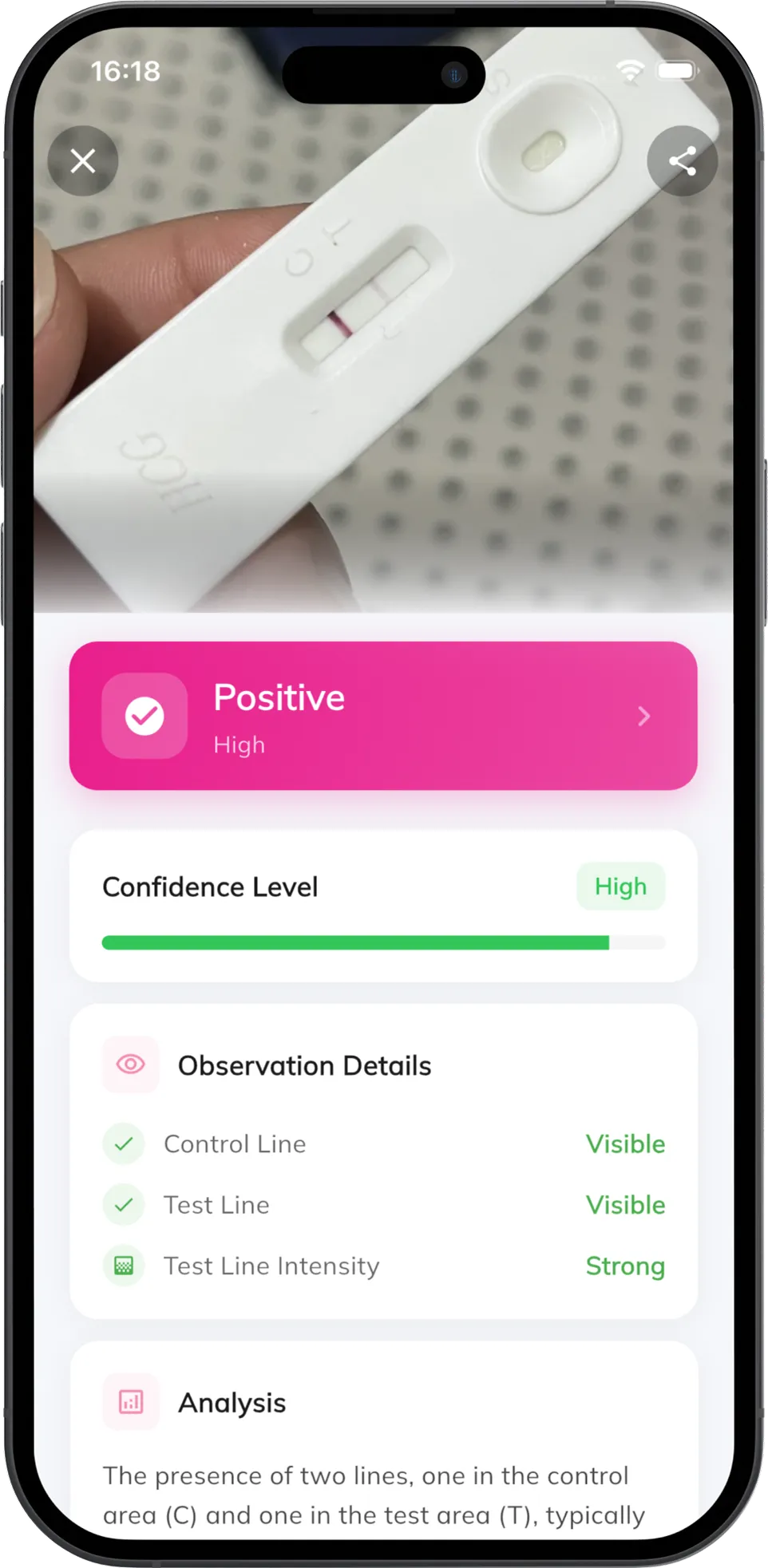
Pregnancy Test Checker + reads a photo of your test and returns a result with a confidence score, including a line-by-line breakdown of what the scan detected in the control zone and test zone. If you have a result that looks like a dye stealer and want a second read on the same image, the app’s analysis shows what each zone registered.
The app supports 11+ brands including Clearblue, First Response, and E.P.T. It works on faint lines and strong positives alike. Everything stays on your device with no account required and no data sent to a server. Pregnancy Test Checker + is described as an estimation tool rather than a clinical device, which is an accurate description of what a photo-reading app can do.
For photos taken within the manufacturer’s reading window, the T zone brightness comparison is where the dye stealer question lives, and that’s exactly what the app reads.
Frequently Asked Questions
Is a dye stealer better than a regular positive?
A dye stealer is a positive result where the test line is visibly darker than the control line. Manufacturers and clinical guidelines don’t assign a health meaning to how dark the test line is relative to the control. Both are positive results; the dye stealer just reflects a higher hCG concentration at the time of testing.
What DPO do most people get a dye stealer?
There’s no fixed day. Based on community testing logs, dye stealers most commonly appear somewhere between 21 and 28 DPO, when hCG has risen well above the basic positive threshold. Earlier results are possible. Timing depends on individual hCG trajectory and the test brand used.
Can you get a dye stealer with a pink dye test?
Yes. Pink dye tests can show a test line darker than the control when hCG is high enough. The effect tends to be less visually dramatic than on blue dye tests because pink dye migrates less during drying, but the same mechanism applies: high hCG loads the T zone with more dye complexes than the C zone receives.
Should I be worried if I never get a dye stealer?
A dye stealer doesn’t appear in every pregnancy. The effect depends on individual hCG levels, test sensitivity, and dye type, so its absence doesn’t carry a specific meaning on its own. A clear positive within the reading window confirms hCG detection. Your provider interprets hCG levels in the context of your full picture.
Pregnancy Test Checker + scans your test photo and returns a line-by-line read of the control and test zones, which is a quick second perspective on any result that looks unexpectedly dark or hard to read.