The question tends to hit around 3 a.m.: contractions are coming, but are they regular enough to leave? Getting to the hospital too early often means being sent home after a quick assessment. Waiting too long carries its own risk, particularly if distance, traffic, or a fast labor is in the picture.
Knowing when to go to the hospital for contractions comes down to timing that pattern consistently, knowing when other signs override any rule, and following the specific instructions your provider gave you at your prenatal visits. This article covers what the common guidelines describe, how first and subsequent births differ, the warning signs that change the calculation entirely, and what triage looks like when you arrive.
Most providers describe a pattern called 5-1-1 as a starting point: contractions five minutes apart, lasting one minute each, for one hour. NHS guidance advises calling your midwife or maternity unit when contractions reach that frequency and duration. Your provider’s specific instructions for your pregnancy always take priority over this or any general guideline.
Hospital Timing for Contractions: The 5-1-1 Rule
The 5-1-1 rule tracks three things at once. Frequency is counted start-to-start: from when one contraction begins to the moment the next one starts. Duration is how long each contraction lasts from first sensation to end. Consistency is whether the pattern holds for at least an hour without spacing back out.
The 5-1-1 rule, one of the most common guidelines for when to call a labor provider, describes contractions that arrive every 5 minutes (measured start-to-start), last approximately 1 minute each, and have held that pattern for 1 hour. The American College of Obstetricians and Gynecologists defines active labor as beginning at around 6 cm cervical dilation, and the 5-1-1 pattern is used in clinical practice as a home-side proxy for approaching that threshold. NHS guidance advises calling a midwife or maternity unit when contractions come every 5 minutes and last 60 seconds. Some providers use a 4-1-1 variation (every 4 minutes, one minute long, for one hour), particularly for people who live farther from their birth center or have had a previous fast labor. Both are starting points. The right timing for any individual depends on their provider’s instructions, their birth history, the distance to the hospital, and any risk factors noted during prenatal care.
One thing the rule doesn’t capture: how strong contractions feel doesn’t always predict how dilated you are. Two people can hit the 5-1-1 pattern at very different points in dilation. Contraction timing tells you when to call. Your provider’s assessment tells you whether to come in.
Why Your Provider’s Instructions Come First
Your midwife or doctor gives you specific guidance before labor starts, and those instructions account for things a general rule can’t: gestational age, any risk factors flagged during prenatal care, your distance from the hospital, your birth history, and whether your waters have broken.
ACOG recommends that care decisions be individualized, which is exactly why your instructions may differ from the standard 5-1-1. Some people are told to call much earlier. Others are advised to wait for a 4-1-1 pattern or a specific contraction intensity. The number your provider gives you reflects your particular situation, not a general population average.
If you can’t reach your provider, most hospital labor and delivery units will talk you through where you are over the phone. Calling before driving in is almost always the right first step.
When to Go to the Hospital for Contractions as a First-Time Parent
For a first birth, the latent phase (early labor) can last many hours. Contractions during this phase are real and can be uncomfortable, but they’re often irregular and not yet progressing cervical dilation quickly. Most providers advise waiting until contractions are stronger, longer, and closer together before making the trip in.
The practical threshold most providers describe for a first birth: contractions closer than 5 minutes apart, lasting a full minute, sustained for at least an hour. Some set that threshold at 4 minutes. If your provider told you 4-1-1, that’s your benchmark for calling, not the more commonly cited 5.
Subsequent births often move faster. Research published in Obstetrics and Gynecology (Zhang et al., 2010) found that the active phase in people who’ve given birth before can progress more quickly once it begins. Many providers advise on a second or later birth to call earlier in the pattern or at the first sign of regular strong contractions, to avoid a fast out-of-hospital delivery.
For a second or later birth, the conversation with your provider about timing is worth having explicitly before 37 weeks.
Signs to Go to the Hospital Right Away
Some situations don’t involve waiting for a contraction pattern at all. These are signs that NHS and ACOG describe as requiring immediate contact or evaluation:
- Water breaking: Call your provider if your membranes rupture, with or without contractions. Most care teams advise coming in within a few hours of rupture.
- Heavy vaginal bleeding: Spotting is common in late pregnancy, but bleeding that resembles a period warrants immediate contact.
- Contractions before 37 weeks: Any regular contractions before 37 weeks are considered preterm labor. The 5-1-1 rule doesn’t apply here. Call right away.
- Decreased fetal movement: A significant reduction in your baby’s movement should prompt a call to your provider without delay.
- Severe or sudden pain that doesn’t follow a wave pattern: Persistent pain that doesn’t build and fade with contractions should be evaluated quickly.
None of these call for waiting to see if the 5-1-1 pattern forms. They warrant a call or a trip to triage without delay.
What Happens at Triage
Arriving at labor and delivery triage doesn’t mean automatic admission. The team assesses cervical dilation, effacement, and fetal heart rate before deciding whether to admit you, observe you for a period, or send you home to wait.
Being sent home happens to a lot of people, particularly with a first birth. It typically means you’re in early or latent labor and your cervix hasn’t reached the active phase yet. Some people make two trips before being admitted, and that’s a common, normal part of first labors.
Bringing your contraction log helps. Triage staff can review frequency, duration, and pattern over the last few hours rather than relying on memory from a stressful drive. That log is one practical thing you can bring that makes the assessment faster and more complete.
Tracking Contractions Before You Head In
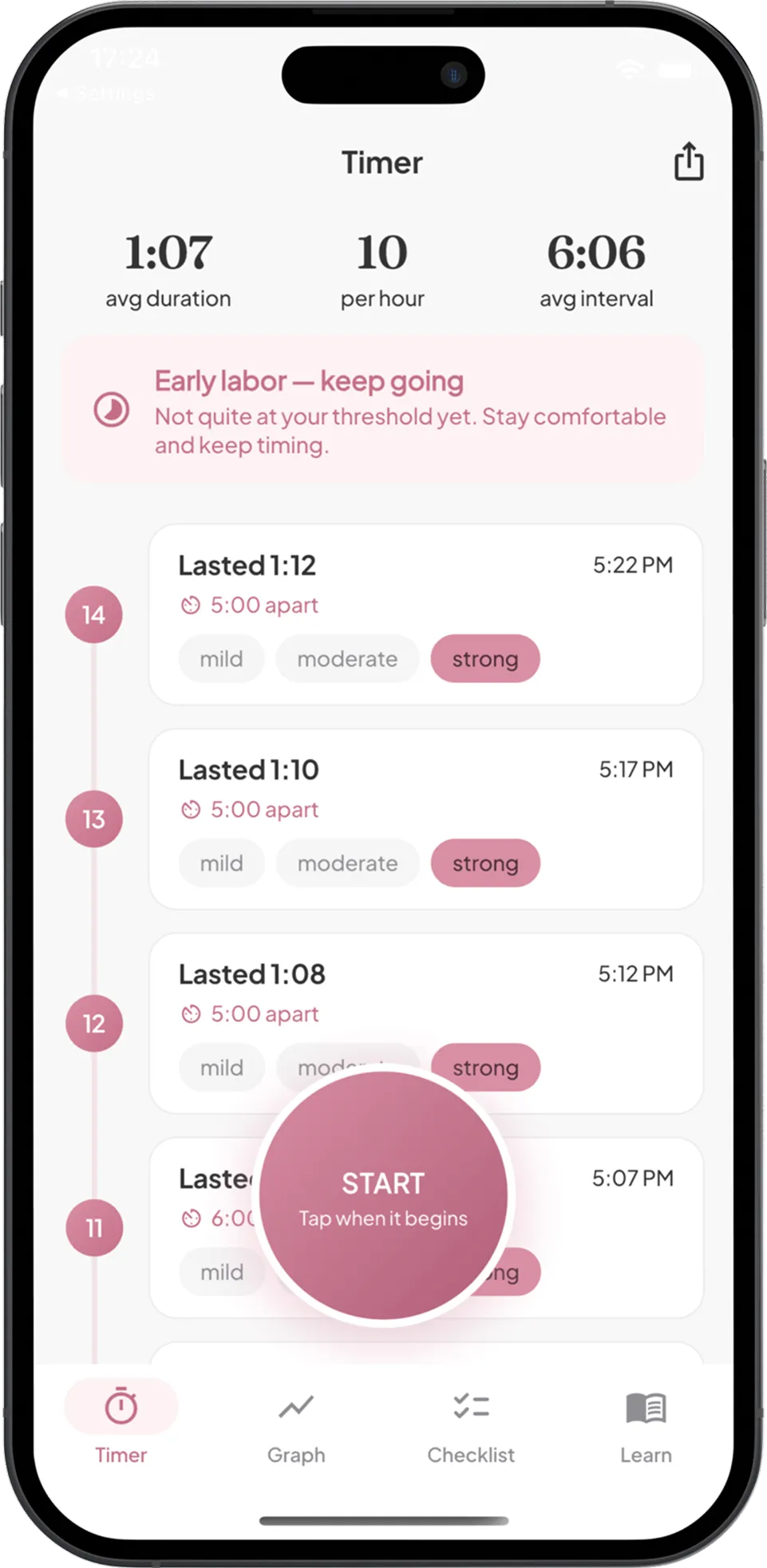
A contraction timer helps you see the pattern clearly and know when you’ve hit the 5-1-1 threshold. It’s also easy to misjudge contraction duration during labor when time feels distorted. Start and stop taps give you an accurate reading rather than a guess.
Contraction Timer & Tracker, the Labor Companion app, logs each contraction with one tap, automatically calculates duration and frequency, and includes a 5-1-1 alert that flags when contractions match the pattern. It defers to your provider’s guidance in the alert text and lets you share the log with a partner or pull it up at triage with one tap.
The free online contraction timer at yourbabyjourney.com works directly in your browser with no download needed. It logs duration and interval, keeps a running hourly summary, and lets you copy the log to share.
If you haven’t thought through how to time contractions yet (specifically, that frequency is start-to-start, not the gap between them), that guide explains the mechanics before you’re in the middle of labor. And if the hospital bag isn’t packed, 36 weeks is a reasonable target so the drive in doesn’t come with extra decisions.
You’re on the labor stage hub for more guides on what to expect from contractions to delivery.
Labor Companion tracks your contraction log and flags the 5-1-1 pattern, with a reminder that your provider’s guidance comes first. Download it for iOS and Android so you have it ready before you need it.
Sources
- American College of Obstetricians and Gynecologists — How to Tell When Labor Begins
- NHS — Signs that Labour Has Begun
- ACOG — Preterm Labor and Birth FAQ
- Zhang J et al. — Contemporary Patterns of Spontaneous Labor with Normal Neonatal Outcomes, Obstetrics and Gynecology, 2010
- NHS — Braxton Hicks Contractions