The hospital bag is one of the few parts of labor you control completely, and it still trips most of us up. I packed mine wrong twice: a stuffed weekender for my first labor, which ran long and left me digging through outfits I never wore, and a half-packed tote for my second, missing the one cable I needed. This hospital bag checklist is the version I wish I’d had, sorted by who each item is for and by when to pack it.
A hospital bag checklist covers three people: the birthing parent, the support person and the baby. Pack the bulk of it around 36 weeks, hold a short last-minute list for chargers and toiletries, and leave the installed car seat in the car. The hospital usually supplies diapers, pads and gowns, so you can pack lighter than most lists suggest.
When to pack your hospital bag
Pack the main bag at about 36 weeks and finish the last-minute items in the final days. The NHS patient guidance on packing for labour says to have your bag ready at least 3 weeks before your due date, which lands around 37 weeks for most people, and it lists your birth plan and hospital notes, comfortable clothes, a phone charger and snacks for the parent, with bodysuits, a hat, a blanket, diapers and a car seat for the baby. The car seat is the one item that can’t wait until you’re leaving: the American Academy of Pediatrics states that all infants should ride rear-facing starting with their first ride home from the hospital, and it suggests working with a certified child passenger safety technician before the baby is born, so the seat is installed and checked while you still have free hands. Treat 36 weeks as the deadline for both the bag and the seat.
That timing leaves a two-layer system that worked far better for me the second time:
- Pack at 36 weeks: clothes, baby items, paperwork copies, spare toiletries, a packed-and-zipped bag by the door.
- Add in the final days: your daily phone charger, glasses or contacts, any prescription medication your provider has told you to bring, fresh snacks, and the toiletries you’re still using every morning.
Tape the second list to the outside of the bag. When it’s time to go, you grab the list, not your memory.
Hospital bag checklist for mom (the birthing parent)
Split your own items into the labor room and the recovery room: different rooms, different hours, mostly different needs.
For labor
- A long, loose shirt or a gown you don’t mind getting messy (most hospitals also offer theirs)
- Grip socks or slippers you can wear on a hospital floor
- Hair ties or a headband
- Lip balm; hospital air is dry
- A water bottle with a straw, so someone can hold it for you
- Your own pillow in a colored case, so it isn’t mistaken for hospital linen
- Headphones and a downloaded playlist or audiobook; hospital Wi-Fi is unreliable
- A hand-held fan or a small battery fan
- A tennis ball or massage oil for back pressure
- A printed birth plan, 2 copies
For after the birth
- A robe or zip-front hoodie, 1 only
- 2 nursing or soft bras, if you plan to breastfeed
- Dark, high-waisted underwear you’d be fine throwing away, or the disposable kind
- Loose pants or a nightdress for the going-home day; choose stretch over structure
- Toiletries: toothbrush, toothpaste, face wipes, dry shampoo, deodorant, a hairbrush
- Nipple cream, if breastfeeding
- A towel if your hospital’s are thin (ask at the tour)
- Flip-flops for the shower
Everything here is generic on purpose. You own most of it already, and brands matter far less than whether you can reach it from the bed.
What the partner or support person should pack
The partner’s bag does double duty: their own things, plus the logistics for both of you. The support person is the only one making trips to the car, so the keys, the parking card and the paperwork folder belong with them.
- A full change of clothes and a sweatshirt; labor floors run cold
- Toothbrush, deodorant, any daily medication
- A phone charger with a cable at least 6 feet long, plus a power bank
- Snacks that don’t need a fridge: nuts, bars, crackers, fruit that travels
- A refillable water bottle
- Cash and a card for the parking garage, vending machines and the cafeteria
- A copy of the birth plan and your preferences for the first hour
- A pillow and a light blanket, because the partner’s chair or cot usually comes with neither
- The paperwork folder (see below) and the car keys
- Something for a quiet stretch: a book, a downloaded show, a notebook
My first labor stretched across a full day, the partner snacks were gone by hour six, and the vending machine took only coins. Pack more food for them than you think, and some of it savory.
What to pack in the hospital bag for your newborn
This is the shortest list, and the one most people overpack. Hospitals keep newborns in their own shirts and swaddles during the stay, so the baby mostly needs things for the trip home.
- 2 outfits: one for the stay, one going-home outfit, in newborn or 0-3 month size
- A hat and a pair of socks or booties
- A light blanket for the car (over the harness straps, never under them)
- A sleeve of 6 to 8 newborn diapers and a small pack of wipes, only if you want a specific kind; the hospital stocks both
- A burp cloth or muslin square
That’s it. The car seat belongs in the car, installed, and the stroller stays at home.
Paperwork, phone and the contraction log
Build one slim folder and keep it with the support person:
- Photo ID and insurance card for the birthing parent
- Pre-registration confirmation, if your hospital does it
- The birth plan, 2 printed copies
- Your provider’s name and the practice phone number written down
- Pediatrician’s name and number, if you’ve chosen one
- Any paperwork your provider asked you to bring (the NHS list, for example, includes your hospital notes)
Then the phone side, which is where I went wrong the second time:
- A long charging cable (hospital outlets live behind the bed, far from where you’ll sit)
- A power bank, charged
- Any downloaded media
- Your contraction log
The contraction log is the item most hospital bag lists skip. On arrival, staff will ask when the contractions started, how far apart they are and how long they last. If you’ve been timing on your phone, that’s in your pocket already; if you used a paper log or the free online contraction timer in a browser, copy the log before you leave the house so it’s there when the question comes.
What the hospital usually provides (so you can leave it at home)
Every hospital is different, so ask at your tour or when you pre-register. In the US, most labor and delivery units supply a gown, postpartum pads, disposable underwear, a peri bottle, ice packs, basic toiletries on request, and for the baby, diapers, wipes, swaddle blankets, a hat and formula if needed. Many will send you home with whatever’s open.
So a checklist built for a hotel stay is too big. Bring the comfort items the hospital can’t personalize (your pillow, robe, toiletries and snacks) and let one question to the maternity unit replace half the lists on the internet.
The car seat rule for leaving the hospital
You can’t drive home without one, and the installation is the part to do early. Per the American Academy of Pediatrics, all infants should ride rear-facing starting with their first ride home from the hospital. The same page suggests meeting a certified child passenger safety technician before your baby is born, so the seat is installed and checked while you still have free hands and a working night’s sleep.
Practical version: install the seat by 36 weeks, get it checked, and leave it in the car. Some hospitals ask to see the seat before discharge and others don’t; ask yours. Pack a light blanket for over the straps rather than a bulky coat, and read the seat’s own manual for harness and recline, since that’s the document that applies to your seat.
What I packed and never used (twice)
Here’s the pile that went home untouched both times:
- 3 of my 4 outfits; I lived in a gown and then a robe
- A speaker (headphones did everything I needed, without annoying anyone)
- A full-size towel; the hospital’s was fine
- 2 books; I read 0 pages
- A box of 40 diapers; the hospital’s open pack came home with us
- A second blanket for the baby
- Make-up, which I’d packed for photos and never opened
What I was glad to have, both times: my own pillow, lip balm, grip socks, a long cable, a water bottle with a straw, and a going-home outfit with a stretchy waistband. The second time I added a notebook for the questions I kept forgetting to ask the nurses, and that one earned its space.
How Labor Companion helps with the hospital bag checklist
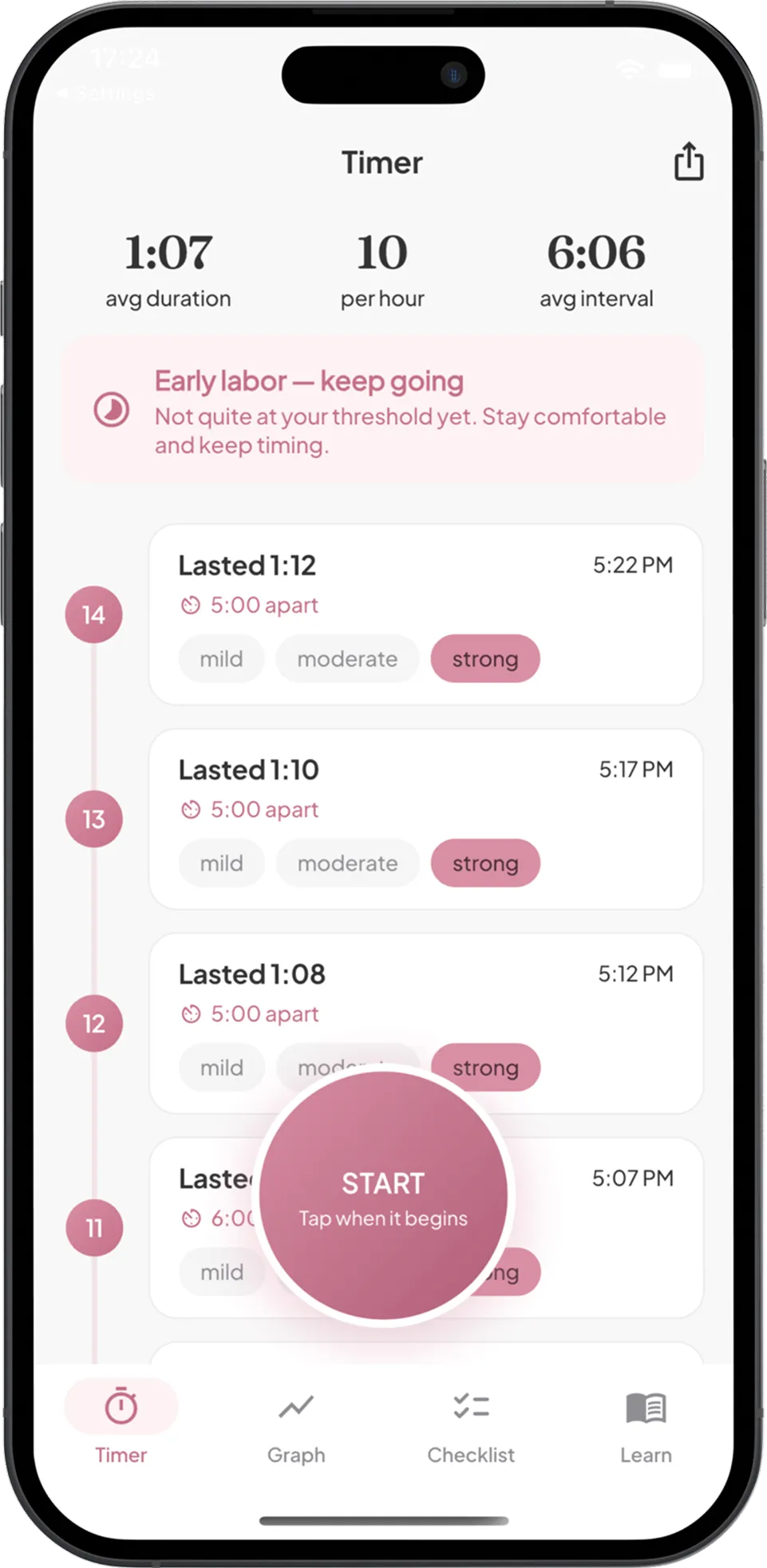
Labor Companion, the in-app name for our Contraction Timer & Tracker, bundles the two jobs that overlap on the night itself: the bag and the timing. It carries a personalized hospital-bag checklist you can tick off at 36 weeks and again on the way out the door, so the paper list lives on your phone instead.
The timer is one tap to start and one to stop. Each contraction lands in a connected history with its duration, the gap since the last one and its intensity, and the hourly graphs show the trend without you doing the math.
When the pattern reaches roughly 5 minutes apart, about 1 minute long, for about 1 hour, the app flags it. That’s the 5-1-1 pattern many providers describe, and the app treats it as a prompt to follow your provider’s instructions, never as a decision made for you.
When you arrive, share the log with your partner or the staff in one tap, which answers the “how far apart” question before anyone has to dig for it. Plain-language guides cover each stage of labor if you want a calm read between contractions.
Everything stays on the device, with no account to set up. The app offers general information, not medical advice.
For the rest of the labor stage, start at the labor hub.
Frequently asked questions
When should I pack my hospital bag?
The NHS suggests having it packed at least 3 weeks before your due date, which works out to around 37 weeks; most people aim for 36 so it’s done before the final stretch. Pack everything that doesn’t need to be fresh, then keep a short last-minute list taped to the bag for the chargers, snacks and toiletries you still use daily.
Do I need to bring diapers and wipes to the hospital?
Usually not. Most hospitals and birth centers stock newborn diapers and wipes for your stay and often send you home with the open pack, so ask when you pre-register or tour the unit. If you want a specific kind, pack a sleeve of 6 to 8 rather than a full box; formula works the same way.
How many outfits should I pack for the baby?
Two is enough for most stays: one for the hospital and one going-home outfit, in newborn or 0-3 month sizes since you won’t know the fit in advance. Add a hat and a light blanket for the car. Babies spend the stay in hospital shirts and swaddles, so extra outfits mostly ride along unworn.
What should my partner pack in the hospital bag?
A change of clothes, a toothbrush, a long phone cable and a power bank, snacks that don’t need a fridge, a refillable water bottle, cash or a card for parking and vending machines, and a copy of the birth plan. The partner’s bag is also the right home for the paperwork folder and the car keys.
Does the hospital check your car seat before you leave?
Policies vary. Some hospitals ask to see the seat before discharge and others don’t, so ask yours when you pre-register. What doesn’t vary is the AAP guidance that all infants ride rear-facing from the first ride home, and the suggestion to have a certified child passenger safety technician check the installation before the birth.
Sources
- NHS, Pack your bag for labour
- American Academy of Pediatrics, HealthyChildren.org, Car Seats: Information for Families, updated 2026-04-16
Pack the bag once at 36 weeks, tape the last-minute list to the handle, and let Labor Companion hold the checklist and the timer in one place, so on the night you’re tapping a button instead of hunting for a cable.