Somewhere in the last weeks of pregnancy, almost everyone encounters the 5-1-1 rule (five-one-one). Contractions 5 minutes apart, lasting 1 minute each, for at least 1 hour. The rule is tidy, memorable, and genuinely useful, but it raises immediate questions.
Is the interval measured start-to-start or end-to-start? What if contractions reach 5-1-1 and then space back out? And why do some providers say 4-1-1 instead?
This guide walks through each number, the science behind why that specific pattern matters, common provider variations, and how to track contractions accurately when it counts.
The 5-1-1 rule describes a contraction pattern many providers use as a rough indicator that active labor may be progressing: contractions arriving every 5 minutes (measured start-to-start), each lasting about 1 minute, sustained for at least 1 hour. The numbers capture consistency and duration together, not just frequency.
What the 5-1-1 Rule Means
The 5-1-1 rule is a timing framework midwives and obstetricians use to identify when active labor may be beginning. It describes contractions arriving approximately 5 minutes apart (measured from the start of one contraction to the start of the next), lasting about 1 minute each, and holding that pattern for at least 1 hour. The American College of Obstetricians and Gynecologists defines active labor as beginning around 6 centimeters of cervical dilation, the stage where contraction frequency and duration typically align with the 5-1-1 pattern for many laboring people. Early labor contractions are usually shorter (under 45 seconds) and spaced further apart. The one-hour window exists because labor patterns fluctuate early on; sustained regularity distinguishes progressive labor from the irregular Braxton Hicks contractions that can appear weeks before active labor begins. Your provider will give you the specific threshold to contact them, as individual circumstances vary.
Each number in the rule carries a distinct meaning:
5 minutes apart means the interval from the start of one contraction to the start of the next is approximately 5 minutes. Many people instinctively measure the gap between contractions (end-to-start), but start-to-start is the standard. If a contraction begins at 2:00, lasts 60 seconds, and the next begins at 2:05, the interval is 5 minutes even though there were only 4 minutes of rest between them.
1 minute long refers to the duration of each contraction. Shorter contractions (30-45 seconds) are typical in early labor. As labor progresses, duration lengthens. One minute is a rough threshold associated with contractions strong enough to drive cervical change, though duration alone doesn’t tell you how your cervix is responding.
1 hour is the sustained window. A handful of 5-minute contractions that then space back out doesn’t meet the standard. Tracking for a full hour distinguishes a consistent, progressive pattern from the fluctuations common in early labor. Braxton Hicks contractions (practice contractions) don’t typically follow a sustained 5-1-1 pattern; they’re usually irregular, shorter, and may ease with movement or hydration.
From Early Labor to Active Labor: What the 5-1-1 Pattern Signals
The 5-1-1 rule exists because active labor looks different from early labor, and contraction patterns are one of the clearest early signals of that transition.
The NHS describes early labour as the phase when the cervix begins to shorten and dilate up to around 4 centimeters. Contractions during this stage are often irregular, lasting 30-45 seconds, and spaced 10-20 minutes apart. They’re real contractions but not yet the sustained, regular pattern of active labor.
As labor progresses, contractions become more frequent, longer, and stronger. The 5-1-1 pattern typically aligns with the approach to active labor for many people, which is why providers use it as a contact threshold. Dilation can only be confirmed by physical examination, so contraction frequency and duration give useful data but don’t tell you exactly where you are on the cervical scale.
Prodromal labor is worth knowing about at this stage. It can produce contractions that look regular for a couple of hours, then fade or space back out. The difference is usually felt in the intensity over time: prodromal contractions tend to stay manageable without changing, while active labor contractions typically build in strength even as they stay on pattern.
For a fuller picture of what to expect as labor unfolds, the labor stage overview covers each phase from early to transition.
Provider Variations: 4-1-1 and When Your Instructions Differ
The 5-1-1 rule is a teaching mnemonic, not a universal clinical standard. Different providers, hospitals, and birth centers use different thresholds.
The 4-1-1 rule (contractions 4 minutes apart, 1 minute long, for 1 hour) is common for first-time parents. Some providers prefer a slightly earlier contact point for first labors, since they can be less predictable and sometimes plateau or progress quickly without warning.
Later thresholds (6-1-1 or longer) are sometimes recommended for subsequent pregnancies, since second and later labors often progress faster. Some providers balance “don’t come in too early” with the reality that the window between first signs and active labor can narrow significantly.
Birth setting matters too. If you’re far from your hospital or birth center, your provider might set an earlier threshold to build in travel time. If your pregnancy has specific factors (group B strep status, previous fast labor, significant distance from care), they may adjust the guideline accordingly.
The specific guidance your provider gives you during prenatal visits is the one to follow. Write it down, save it in your phone, and keep a copy in your hospital bag alongside any other birth plan notes. If you haven’t received a specific threshold yet, ask at your next visit; most providers will tell you exactly which pattern to use and when to call.
How to Time Contractions Accurately
The start-to-start interval is what matters, but tracking it reliably during active labor is harder than it sounds.
What to record with each contraction:
- Start time (when the tightening begins)
- End time (when it fully fades)
- Duration (end minus start)
- Interval (start of this contraction minus start of the previous one)
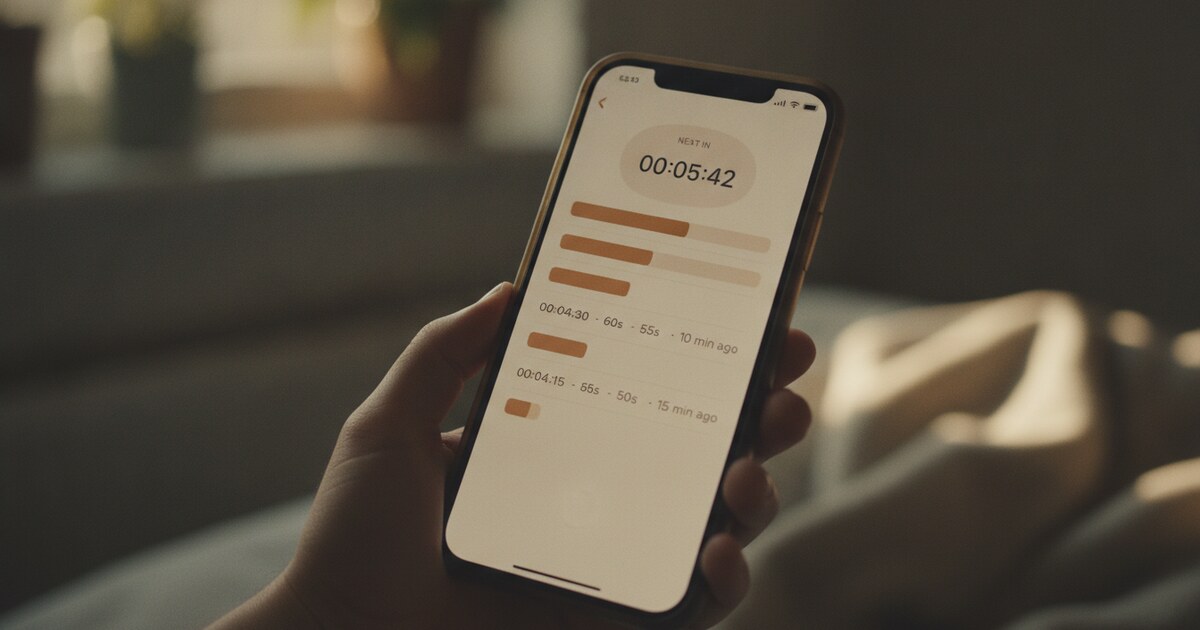
Doing this by hand is manageable in early labor when contractions are well-spaced. Once they’re 5-7 minutes apart and intensifying, the mental math becomes difficult. Using a dedicated contraction timer reduces the cognitive load: tap when it starts, tap when it ends, see the intervals and averages automatically.
After 60 minutes of consistent tracking, you’ll have a log that shows whether the pattern is truly 5-1-1 or whether it’s still fluctuating. If you’re calling your provider, sharing a concrete log (“10 contractions over the past hour, averaging 5.2 minutes apart and 58 seconds long”) is more useful than a rough estimate.
If your contractions are consistently running 45-50 seconds rather than a full minute, share that with your provider. It might suggest you’re in the earlier phase of labor, or it could mean the method of counting needs a small adjustment. Either way, it’s useful data for the conversation.
What to Watch for Regardless of the Pattern
The 5-1-1 rule is useful for tracking progressive labor, but some situations mean contacting your provider regardless of contraction frequency.
ACOG’s patient guidance on labor includes contacting your provider if your water breaks (membranes rupture), if you notice any vaginal bleeding that concerns you, or if you have reduced fetal movement. These are contact signals that don’t depend on the contraction pattern.
Contractions that become very intense and very close together (2-3 minutes apart) in a short period are another reason to contact your provider without waiting for the full hour. Active labor can accelerate quickly for some people, and fast-progressing patterns warrant a call even if they’re recent.
The labor line at your birth center or hospital is there for exactly these moments. If you’re unsure whether what you’re experiencing is active labor, calling the triage line is the right move.
How Labor Companion Tracks the 5-1-1 Rule
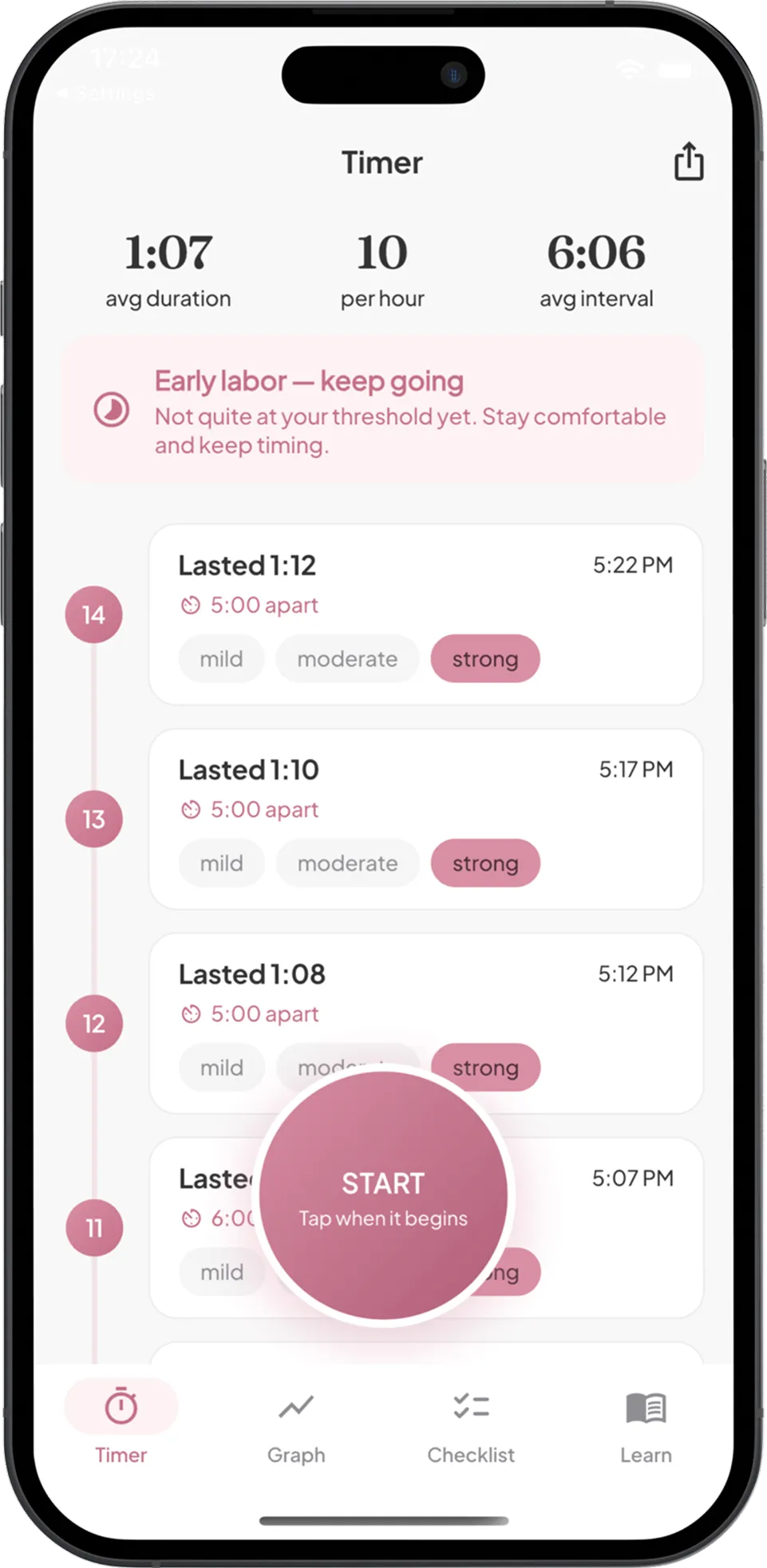
Contraction Timer & Tracker (Labor Companion) is designed around the 5-1-1 rule. It has a built-in alert that flags when your pattern matches the guideline: contractions about 5 minutes apart, lasting about 1 minute, sustained for about an hour. The app describes this as “a common sign it may be time to head to your birth place” and always notes to follow your provider’s specific guidance.
One-tap timing means you don’t need to calculate intervals during a contraction. The app tracks duration, frequency, and intensity automatically, then shows hourly graphs and trends. When you’re ready to call your provider or head to your birth place, you can share the full contraction log in one tap.
Before labor starts, the hospital bag checklist on this site walks through what to pack and when to do it. The free online contraction timer at Your Baby Journey works in a browser with no account required if you want to try the timing tool first.
Your provider’s instructions are your first reference when contractions start. Labor Companion keeps the data organized so you have something concrete to share when you make that call.
Sources
- American College of Obstetricians and Gynecologists. How to Tell When Labor Begins. ACOG Patient FAQ.
- NHS. Signs that labour has begun. NHS.uk.
- American College of Obstetricians and Gynecologists; Society for Maternal-Fetal Medicine. Safe Prevention of the Primary Cesarean Delivery. Obstetric Care Consensus, 2014.