Nine days past ovulation (9 DPO) lands right at the point where implantation has typically finished for most pregnancies, but hCG hasn’t had much time to climb. Whether a test returns a positive at 9 DPO comes down to two things: when implantation happened and how sensitive the test is.
This article covers the implantation biology, what typical hCG levels look like at 9 DPO, what different test sensitivity thresholds mean for early results, and how to read whatever the strip shows. There are no symptom lists here.
For the previous day in this series, see 8 DPO: What a Pregnancy Test Can Show. The how many DPO can you test guide maps the full sensitivity picture across the two-week wait.
A pregnancy test at 9 DPO can return a positive, but a negative is still the most common result, even in confirmed pregnancies. Implantation can complete as late as 12 DPO, and hCG rises from nearly zero at that point. Community data from Countdown to Pregnancy shows roughly one in four pregnant people see a positive at 9 DPO.
Where Implantation Stands at 9 DPO
A pregnancy test measures hCG (human chorionic gonadotropin), a hormone the embryo produces only after it attaches to the uterine lining. Before that attachment, hCG is essentially absent.
A 1999 study by Wilcox, Baird and Weinberg, published in the New England Journal of Medicine, tracked 221 women through 287 conception cycles and found that implantation completes between 6 and 12 DPO. For ongoing pregnancies, 84% implanted within the 8 to 10 DPO window. hCG production starts once implantation is complete and doubles every 48 to 72 hours in a developing pregnancy, per ACOG guidance on early pregnancy loss. Someone implanting at 9 DPO will have essentially zero hCG that day. Someone who implanted at 6 or 7 DPO may have had two or three doubling cycles already, putting hCG somewhere in the range of 2 to 8 mIU/mL. Community data from Countdown to Pregnancy, compiled from thousands of home test results, shows roughly one in four pregnant people tested positive at 9 DPO. The remaining three in four tested negative, with most going on to see a positive by 11 to 13 DPO as hCG climbed through the detection range.
That spread in implantation timing is why 9 DPO results vary so widely between people and why community data, not expectation, is the most useful benchmark here.
What a Test Can Actually Detect at 9 DPO
A test can only return a positive when hCG in urine crosses its detection threshold. Those thresholds differ substantially across brands.
- First Response Early Result (FRER): 6.3 mIU/mL, per the manufacturer’s instructions
- Clearblue Early Detection: approximately 10 mIU/mL
- Standard strip tests and most digital tests: 20 to 25 mIU/mL
For a test to return positive at 9 DPO, implantation would need to have finished by around 6 to 7 DPO, giving hCG enough doubling cycles to reach even FRER’s 6.3 mIU/mL floor. For most people, whose implantation happens closer to 8 to 10 DPO, hCG is still below that floor on day 9.
A 2014 review by Gnoth and Johnson tested the actual sensitivity of widely available home tests and confirmed a wide gap between brands. Some early detection tests in the review didn’t consistently hit their labelled sensitivity in real use, making test selection at this early stage more consequential than it might appear.
At 9 DPO, FRER with first-morning urine gives the best chance of catching hCG that’s only just cleared the detection floor. Standard tests are unlikely to return a positive until hCG passes 20 mIU/mL, which typically happens between 10 and 13 DPO depending on implantation timing.
Why Some 9 DPO Tests Do Turn Positive
The one-in-four positive rate at 9 DPO isn’t random. It reflects a specific scenario: implantation happened early (6 to 7 DPO, which occurs in a smaller proportion of pregnancies), and hCG has had time to climb through two or three doubling cycles.
Doubling from implantation at 6 DPO, at the lower end of the normal 48 to 72 hour range, might look like this:
- 6 DPO (day of implantation): under 1 mIU/mL
- 8 DPO: approximately 2 to 4 mIU/mL
- 9 DPO: approximately 4 to 8 mIU/mL
That range, while very low, crosses the 6.3 mIU/mL floor of FRER. On a standard test requiring 20 mIU/mL, the same pregnancy would still read negative.
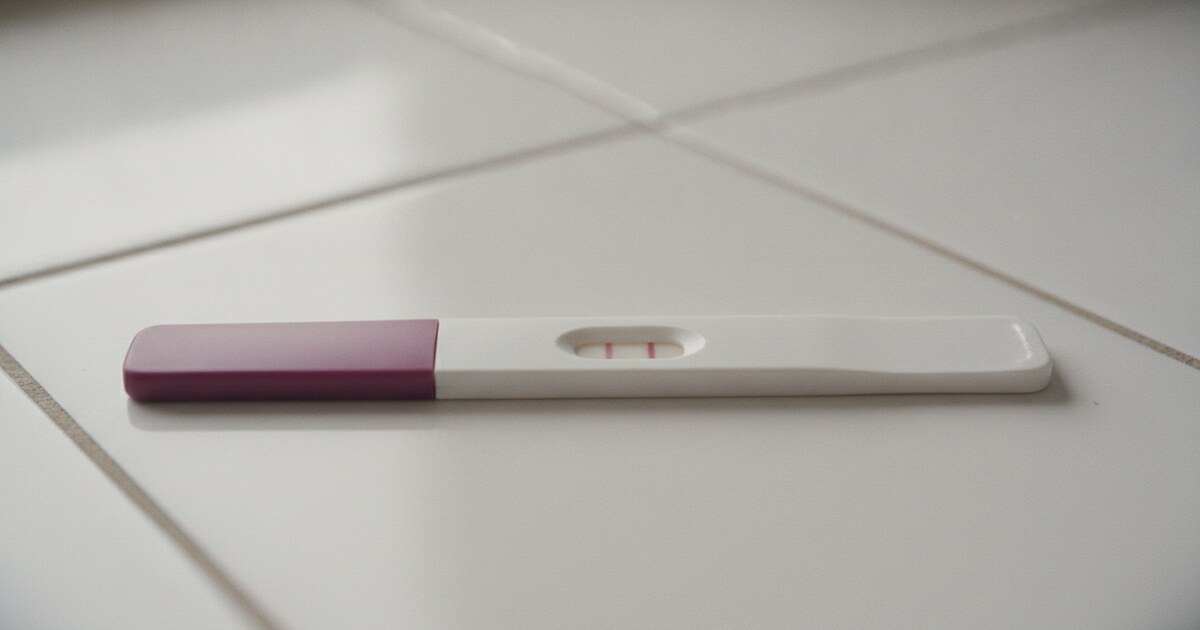
This is why a positive at 9 DPO is almost always faint. The line is real; hCG is detectable. For how to tell a genuine faint positive from an evaporation artifact, the evaporation line vs faint positive guide covers both by dye type.
How to Read a 9 DPO Result
The same reading rules apply at 9 DPO that apply throughout early testing.
Read within the manufacturer’s window. Most brands specify 3 to 10 minutes. A line appearing after the window closes is likely an evaporation line. Any line that appears within the window is read as a positive per most manufacturer instructions.
Use first-morning urine. At 9 DPO, hCG is low enough that concentration matters. First-morning urine, collected after several hours without fluids overnight, is more concentrated and gives the test the best chance at a marginal signal. Most early-detection test manufacturer instructions note that first-morning urine is particularly important before a missed period.
Any line within the window counts. Faint doesn’t mean false. Per most manufacturer instructions, any visible line in the test-line area within the reading window is a positive, regardless of intensity.
A negative at 9 DPO doesn’t close the cycle. Per NHS guidance, testing from the first day of a missed period gives the most reliable result. Manufacturer instructions for early-detection tests note that a negative before a missed period may not mean the cycle has ended.
When Testing Starts to Give Clearer Information
The shift from noise to signal happens across the days following 9 DPO, as hCG doubles through the detection range of progressively less sensitive tests.
10 to 11 DPO. For pregnancies with 8 to 9 DPO implantation, hCG often reaches 6 to 15 mIU/mL in this window. A FRER faint line becomes realistic; standard tests are still likely to read negative.
12 to 13 DPO. Community data from Countdown to Pregnancy shows the majority of pregnant people who test at 12 to 13 DPO on a sensitive test see a positive. hCG is now climbing through the 10 to 25 mIU/mL range for most implantation timings.
14 DPO. The NHS recommends testing from the first day of a missed period. By this point, most tests return a clear answer in a viable pregnancy.
The when-to-test calculator works out the earliest realistic testing window from your ovulation date. The full two-week wait timeline is covered at the waiting-and-testing hub.
How Pregnancy Test Checker Helps at 9 DPO
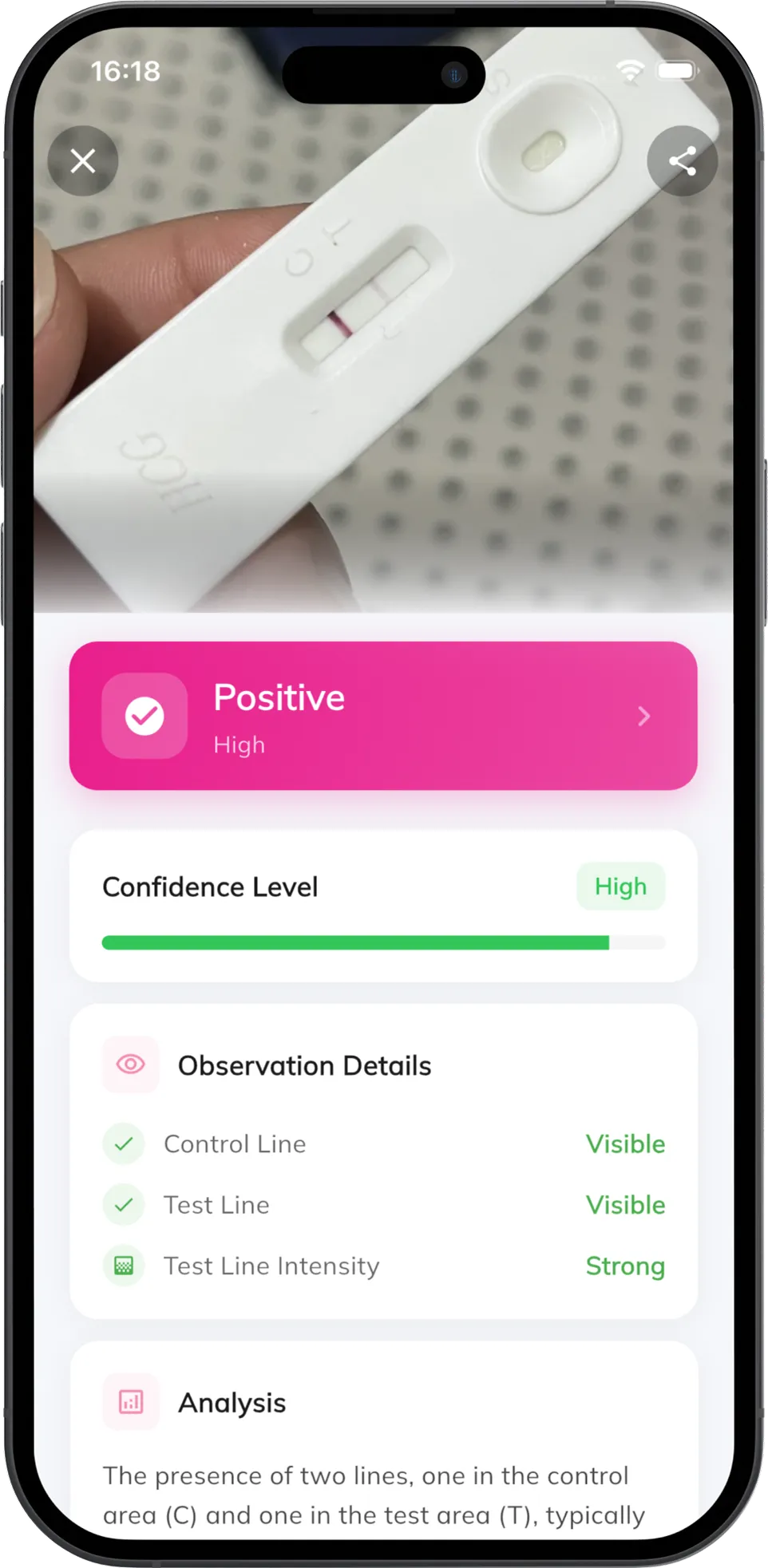
A 9 DPO faint line is real but often barely visible under bathroom light. Pregnancy Test Checker + scans a photo of your strip and returns a confidence score along with a line-by-line read: control line, test line, pattern. It supports First Response, Clearblue, and 11+ other brands.
The faint line detection is designed for exactly this scenario. Premium access adds a full breakdown so you’re not squinting at the strip alone and second-guessing the result. All scans stay on your device; the app is informational and doesn’t confirm or diagnose a pregnancy.
Frequently Asked Questions
Can you get a positive pregnancy test at 9 DPO?
Yes, though it’s still uncommon. Community data from Countdown to Pregnancy shows roughly one in four pregnant people who test at 9 DPO see a positive. Most negatives at this stage reflect hCG that hasn’t crossed the test’s threshold yet. A positive at 9 DPO, however faint, means the hormone was detectable by the test.
Does a negative at 9 DPO rule out pregnancy?
No. Implantation can occur up to 12 DPO (Wilcox et al., 1999), and hCG starts rising only after implantation is complete. For many people, hCG at 9 DPO hasn’t reached even the most sensitive test’s threshold. The NHS recommends testing from the first day of a missed period for the most reliable result.
Which pregnancy test is most sensitive at 9 DPO?
First Response Early Result is rated at 6.3 mIU/mL by the manufacturer, making it one of the most sensitive options available. Clearblue Early Detection is rated at around 10 mIU/mL. Standard strip tests require 20 to 25 mIU/mL, a threshold hCG rarely reaches by 9 DPO except in pregnancies with earlier-than-average implantation (Gnoth & Johnson, 2014).
How does 9 DPO compare to 10 or 12 DPO for testing?
Each day adds roughly one hCG doubling cycle, which can push levels from below detection to above it. Countdown to Pregnancy data shows positive rates climbing sharply from 9 to 12 DPO. A negative at 9 DPO on a sensitive test often becomes a clear positive by 12 DPO as hCG doubles through that range.
Sources
- Wilcox AJ, Baird DD, Weinberg CR. “Time of implantation of the conceptus and loss of pregnancy.” N Engl J Med. 1999;340:1796–1799.
- NHS. “How soon can I do a pregnancy test?” nhs.uk
- ACOG Practice Bulletin No. 200: Early Pregnancy Loss. May 2018. acog.org
- Gnoth C, Johnson S. “Strips of hope: accuracy of home pregnancy tests and new developments.” Geburtshilfe Frauenheilkd. 2014;74(7):661–669.
- Countdown to Pregnancy. “Statistics on positive tests at 9 days past ovulation.” countdowntopregnancy.com
- First Response Early Result Pregnancy Test. Product information. firstresponse.com